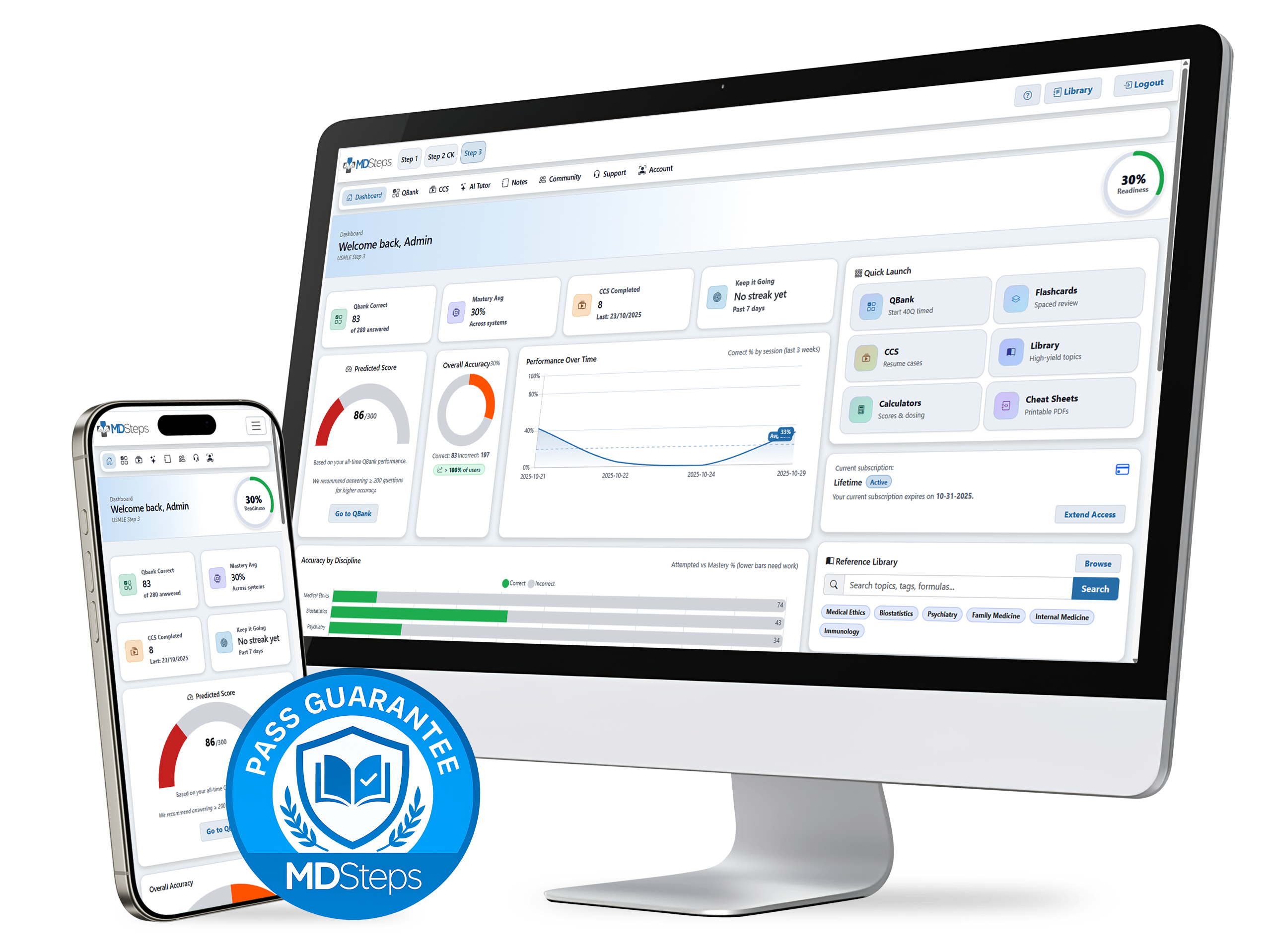
The USMLE® Prep
Built to Fix Stalled Scores
MDSteps isn’t just another question bank.
It’s built for the moment when you’ve done the content — and your score still won’t move.
We show you how exam questions actually force decisions: which clues mattered, which details were noise, and why the wrong answers felt right. That’s the skill that unlocks the next score jump.
Already have an account? Log inWhy MDSteps
Built for the Moment Scores Stop Moving
Reasoning-First Questions
Questions built to surface decision mistakes — not just test recall — so the same errors don’t stay hidden across blocks.
Depth-on-Demand™
Layered explanations that show what actually mattered in the stem, why tempting answers fail, and how the correct choice becomes unavoidable.
Pattern-Level Insight
See the patterns behind your misses — recurring traps, misreads, and unstable systems — without drowning in charts or noise.
Clinically Grounded
Written by experienced educators and clinicians, focused on how medicine is tested under pressure, not just how it’s described in textbooks.
What This Gives You in Practice
- Explanations that teach you how to recognize patterns, not memorize facts.
- Why-wrong logic that stops the same 50/50 mistakes from repeating.
- Depth-on-Demand™ breakdowns when a question doesn’t immediately click.
- Targeted refreshers based on how you miss — not how many you miss.
- Decision-focused tools aligned to Step 1, Step 2 CK, and Step 3/CCS.
See How MDSteps Can Help You
Turn Your NBME Pattern Into a Clear Plan
Drop in your last few NBME scores and we’ll show you why your score feels stuck — and how MDSteps’ reasoning-first platform would attack your exact pattern.
What this wizard does:
- Reads your NBME trend (rise, plateau, dip, or noisy).
- Spots likely reasoning problems behind the numbers.
- Shows how MDSteps’ Depth-on-Demand™ Dissections and pattern tags would re-train your approach.
This is a demo based on the same logic MDSteps uses internally: diagnose the pattern, then fix the thinking — not just pile on more questions.
What do your scores mean?
What feels like it’s holding you back?
What this would look like inside MDSteps
- Pattern tagging: MDSteps quietly tracks which systems, stem phrases, and distractor styles you keep missing — turning your “plateau” into a map of specific blind spots.
- Depth-on-Demand™ Dissections: every question breaks down the NBME-style reasoning steps, the trap you almost fell for, and an algorithm you can reuse on similar items.
- The Exam Readiness Dashboard turns this pattern into a clear, week-by-week plan.
Depth-on-Demand™ Review
Review Designed for How You Actually Learn
Under Exam Conditions
Depth-on-Demand™ turns every question into a reusable way of thinking. You don’t get a long paragraph — you get the decision path, the traps, and the exact clue that forced the answer.
One question. One decision. Three layers you can reuse.
The Signal
The one detail that matters most — the mechanism, rule, or threshold that makes the answer inevitable.
- Spot the “pivot” clue fast
- Know why the correct answer is correct in 20–30 seconds
The Differentiators
The exact features that separate look-alikes — so the same 50/50 doesn’t show up again tomorrow.
- “If X is present → rule out A; if Y → choose B” logic
- Why-wrong notes that call out the trap your brain took
The Stem Decoder
The full reasoning rebuild: signal vs noise, hidden constraints, and how the stem forces a single best choice.
- Stem → inference → decision (the exam-day chain)
- Pattern tags that connect this item to others like it
Move fast when it’s obvious. Go deeper only when it isn’t. Depth-on-Demand™ gives you just enough clarity — without wasting your time.
You’re Not Just Reviewing.
You’re Rewiring How You Choose Answers.
Most explanations tell you facts you already “knew.” Depth-on-Demand™ shows why you still missed — misreads, traps, and decision errors — and fixes the pattern at the source.
- Recognize the clue that makes the correct answer unavoidable
- See why tempting distractors exist (and why they work on you)
- Turn each miss into a reusable rule for the next similar question
The goal isn’t to understand one item. It’s to stop repeating the same mistake pattern.
Layered reasoning on every question • Steps 1–3
Stem Decoder • Live Example
One question. One decision structure. Three levels of clarity.
Likely miss type: Misdiagnosis (pattern confusion)
The pivot point
The Science Behind MDSteps
Why Smart Students Still Get Stuck — And How to Fix It
When everything feels familiar — but nothing feels obvious.
Plateaus usually don’t come from missing knowledge. They come from cognitive overload: too many half-learned rules, too many similar answers, and not enough clarity about what actually matters.
Under exam conditions, your brain defaults to fast pattern-matching. If those patterns are fuzzy or inconsistent, you feel stuck in 50/50s — even on topics you “know.”
MDSteps is designed to stabilize those patterns. You make a decision first, then see the exact reasoning structure that forced the answer — starting with the signal and expanding only when needed.
The brain learns decisions by making them — not by rereading explanations.
- You commit to an answer before seeing any reasoning.
- Weak patterns resurface until they become stable, not familiar.
- Depth-on-Demand™ shows only the layer you need to correct the miss.
Exams reward stable sequences, not clever improvisation.
- CCS Runner trains a fixed loop: Stabilize → Diagnose → Treat → Reassess.
- Timing and order become automatic, freeing cognitive bandwidth.
Your brain needs pattern feedback — not just a score.
- Misses are tagged by why they happened, not just what topic they were.
- You see which reasoning habits are stabilizing and which still leak points.
- Each block feeds a clearer plan for the next one.
What Students Say
A Better Way to Think Through Questions
I got a 198 on two NBMEs back-to-back and honestly thought I was getting worse. I couldn't afford to buy another big resource, so I tried this kind of out of panic. It immediately pointed out stuff I didn’t realize I was consistently screwing up the same pharm topics, same misreads, same style of mistakes. I spent about two weeks fixing those and my next NBME (27) came back as a 207. Not a crazy jump, but it was the first time I felt like I wasn’t blindly studying. It actually gave me some hope again.
— A.M., Step 1
CK was destroying me. I did like 2k questions and still had no clue why my score was stuck around 229–232. This thing basically showed me, in plain English, the three systems I kept messing up. I focused on those for a couple weeks and my NBME 13 went to 238. The best part was honestly that I didn’t have to extend my Qbank again, so I actually saved money. It finally felt like I was studying smarter instead of just grinding.
— K.R., Step 2 CK
I was okay on the MCQs but CCS was ruining my Step 3 score prediction. I didn’t want to spend hundreds on a tutor, so I tried practicing cases here. It helped way more than I expected. I stopped panicking every time the timer started because I finally had an actual plan. My predicted score went up about 10 points after a few weeks. For the price, it ended up being the most useful part of my prep.
— S.L., Step 3