82%
Reported an increase or pass after using MDSteps
The strongest signal is outcome-based: users report that MDSteps helped them move forward.
Free reasoning diagnostic for USMLE® students
If you keep narrowing questions to two choices and picking the distractor, MDSteps shows the pivot clue you missed, why the wrong answer felt right, and what pattern to fix before your next block.
The plateau problem
Some misses are content gaps. But many are mechanics problems: missing the pivot clue, over-weighting a distractor, changing away from the right answer, or reading the stem without knowing which detail should control the decision.
The topic was familiar, but the stem gave you two plausible choices and the explanation did not make the decision feel reusable.
One age, lab, timing clue, modifier, or negative finding should have ruled out the tempting distractor.
You understood the answer afterward, but the same kind of miss showed up again on the next block or NBME.
How MDSteps works
Start with one free question review. We’ll show the clue you missed, why the wrong answer felt right, and what to catch on your next block.
Start the Free DiagnosticStart with an actual question designed to expose common NBME-style traps, pivot clues, and distractor pull.
See why your selected choice was tempting, what clue should have changed your thinking, and how the correct answer survives.
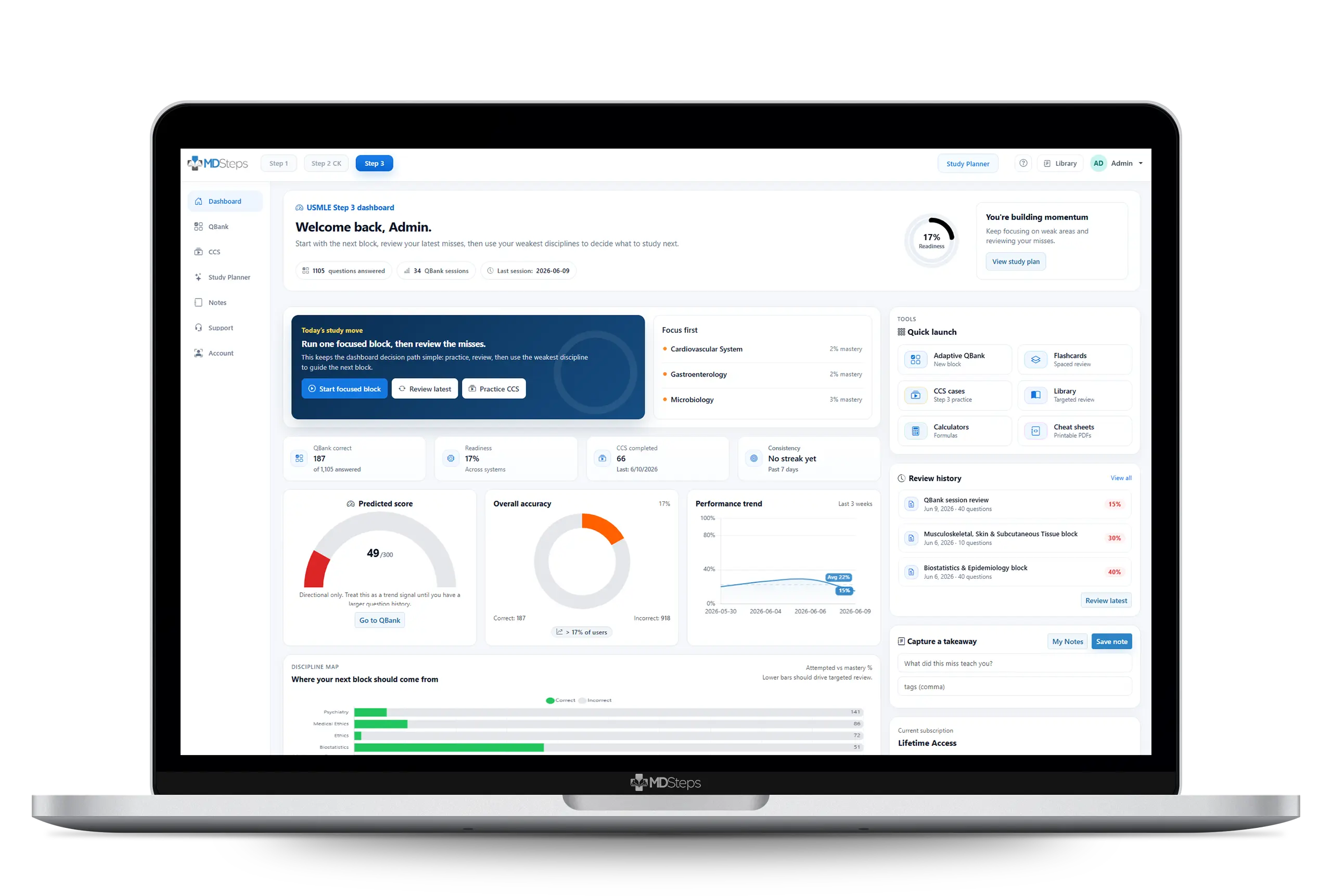
Inside MDSteps, future blocks, reviews, flashcards, and analytics are organized around the mistake patterns you need to fix.
How MDSteps teaches
MDSteps turns each miss into a repeatable rule: what mattered, what was noise, why the distractor was tempting, and what you should catch next time.
A patient is found unresponsive with severe depression and chronic back pain. She is breathing deeply and rapidly. ABG: pH 7.42, PaCO2 20, HCO3- 12.
Choose your path
Some students need help with question-reading traps. Others need a safer workflow for CCS. Start with the path that matches your exam problem.
Use this path if your NBME score is flat, your reviews feel inefficient, or you keep narrowing to two answers and choosing the distractor.
Use this path if the CCS interface, order timing, case closure, or grading feels opaque and you want to practice before paying.
Why students use MDSteps
MDSteps teaches what most QBank explanations skip: how the question was built, why the wrong answer felt right, and what to catch next time.
Each review separates the pivot clue, answer logic, distractor logic, and takeaway rule so the miss becomes easier to reuse.
See recurring mistakes by system, clue type, distractor style, and reasoning habit instead of relying on raw percentages alone.
Start with the quick signal, then go deeper when a question does not click, without turning every review into a text wall.
“I got a 198 on two NBMEs back-to-back and felt stuck. MDSteps showed me I was repeating the same pharm and misread patterns. Two weeks later my next NBME was 207.”
“CK was stuck around 229–232 even after thousands of questions. MDSteps made the weak systems and question traps obvious. I focused there and my NBME 13 moved to 238.”
“For Step 3, CCS was what scared me. Practicing cases here gave me an actual workflow instead of panicking when the timer started.”
Student examples are shared with initials to protect privacy. Individual results vary and depend on baseline performance, study time, exam timing, and how consistently the platform is used.
Insights from MDSteps user polls
In a recent user poll, students most often report progress after using MDSteps as a targeted reasoning repair layer, especially when NBME scores plateau, answer choices blur, or a prior score drop creates uncertainty.
The strongest signal is outcome-based: users report that MDSteps helped them move forward.
Figures are based on self-reported MDSteps user polls conducted March 2026. Individual outcomes vary by baseline, exam timeline, question volume, and consistency of use.