USMLE® Step 2 CK
USMLE Step 2 CK prep for the 50/50 next-step questions costing you points.
Step 2 CK questions often come down to timing, safety, and the next best step. If you keep narrowing to two answers, missing management questions, or watching your NBME/CMS score stall despite doing blocks, MDSteps helps diagnose the decision pattern behind the miss — then shows you what to practice next.
Start with the free Step 2 reasoning diagnostic. Full access is $27/month after upgrade and includes the Step 2 CK QBank, Step 1, Step 3, 135 interactive CCS cases, Depth-on-Demand™ explanations, miss-pattern analytics, auto-flashcards, and study planning.
What Step 2 CK feels like when you are stuck
- You know the likely diagnosis, then lose the point on the next step.
- You mix up “best test,” “best initial test,” and “best immediate management.”
- You get stuck between admit, observe, discharge, or consult.
- Ethics, communication, and patient-safety questions feel less predictable than the medicine.
- Your NBME, CMS, or UWSA score is not reflecting the number of questions you have done.
Free Step 2 CK reasoning diagnostic
Find out why your “almost right” Step 2 answers keep becoming misses.
The free diagnostic is designed to create the first MDSteps “aha”: not just whether you got the item right, but whether your miss came from stabilization timing, diagnostic-vs-treatment sequence, disposition thresholds, ethics framing, or a tempting-but-wrong next step.
Common Step 2 CK pain points
If Step 2 CK feels unpredictable, the issue may be decision-making — not effort.
USMLE Step 2 CK rewards more than knowing the diagnosis. It tests whether you can prioritize, sequence care, and choose the safest next action under pressure.
“I keep picking the second-best next step.”
Step 2 CK answer choices can all sound reasonable. MDSteps helps you see why one option is right now and another is right later.
“Admit vs outpatient keeps tripping me up.”
Disposition questions depend on instability, risk scores, social support, pregnancy, age, and follow-up reliability. MDSteps trains those cues directly.
“I forget whether to stabilize, test, or treat first.”
MDSteps emphasizes order-of-operations logic: resuscitate first, confirm when needed, treat when delay is dangerous.
“My NBME or CMS score is stuck.”
More blocks do not always fix repeated decision errors. MDSteps helps identify the management patterns behind your Step 2 misses.
“Ethics and communication feel random.”
These questions usually test a pattern: patient autonomy, safety, confidentiality, capacity, or nonjudgmental communication.
“Rotations make studying inconsistent.”
MDSteps helps turn small pockets of time into focused practice without losing track of weak areas.
How MDSteps helps
Turn the Step 2 CK miss into the rule you needed.
Step 2 CK improvement usually starts when a vague miss becomes a clear decision pattern: what mattered, what tempted you, and what to do differently next time.
You know the diagnosis but miss the next best step.
Diagnosis is only part of Step 2 CK. The exam often asks what action is safest, most urgent, or highest yield for this patient right now.
Management-pathway explanations
See why the correct step comes now, why tempting alternatives come later, and which clue determines the sequence.
You miss admit vs outpatient questions.
Disposition can hinge on instability, risk, pregnancy, age, social support, or failure of outpatient therapy.
Disposition and threshold training
Practice admission criteria, risk tools, safety red flags, and outpatient follow-up logic in realistic clinical stems.
You fall for answers that are medically true but wrong here.
Many Step 2 CK distractors are not nonsense. They are too early, too late, too invasive, incomplete, or unsafe for this moment.
Why-wrong clinical reasoning
MDSteps names the trap so you can recognize it later: delayed care, over-testing, over-treatment, missed instability, or wrong setting.
Your shelves, rotations, and CK prep feel disconnected.
Students often study what is urgent this week and lose track of the management patterns that matter for long-term CK readiness.
Analytics + rotation-aware study planning
Track weak specialties, management themes, timing, and recurring miss patterns across shelves, CMS forms, NBMEs, and CK-style blocks.
The point is not another block. It is finding the decision rule you keep missing.
Use the free diagnostic to see whether your misses come from timing, stabilization, disposition, over-testing, or trap answers.
The Step 2 workflow
A calmer way to build Step 2 clinical judgment.
Use MDSteps as a loop: practice a clinical decision, decode the sequence, tag the miss, and repeat the pattern until it stops costing points.
Start a clinical block
Choose mixed, specialty-based, shelf-style, or targeted management blocks.
Decode the sequence
Learn why the best step comes before the other reasonable steps.
Tag the decision error
Was it stabilization, diagnostic order, treatment threshold, disposition, ethics, or timing?
Practice the pattern again
Build targeted review around the decisions you keep missing.
See the difference
Step 2 CK questions are often about timing, safety, and sequence.
In clinical vignettes, multiple answers can be medically true. The question is which one is safest, most appropriate, or most urgent for this patient right now.
- Disposition cues: inpatient, outpatient, ICU, observe, consult, or discharge.
- Management sequence: stabilize, test, treat, reassess, counsel.
- Why-wrong logic: why a plausible answer is wrong now.
- Pattern tags: the decision habit you need to fix.
When you miss a Step 2 question, MDSteps asks:
- Was the patient unstable?
- Was the next step diagnostic or therapeutic?
- Was the answer too invasive, too delayed, or incomplete?
- What clue determined disposition or urgency?
Step 2 CK coverage
Specialties, task types, and clinical competencies — connected to decisions.
Step 2 CK is not just clinical knowledge. It is clinical prioritization across specialties, settings, and patient-safety scenarios.
Specialty coverage
- Internal Medicine, Surgery, Pediatrics, OB/GYN, Psychiatry, Neurology, Emergency Medicine, and Family Medicine.
- Preventive care, screening, vaccination, prenatal care, contraception, and chronic disease management.
- Perioperative management, antibiotic selection, prophylaxis, and complication recognition.
- Ambulatory, emergency department, inpatient, ICU, and discharge planning contexts.
Task types
- Next best step in diagnosis, treatment, stabilization, disposition, or prevention.
- Interpretation of labs, ECGs, imaging, bedside tests, and clinical trajectories.
- Ethics, communication, patient safety, quality improvement, and professionalism.
- Biostatistics, study design, screening thresholds, and clinical decision tools.
Step 2 CK features
Everything is aimed at better Step 2 CK decisions.
Not just more blocks. Better feedback on what went wrong in the decision.
How MDSteps fits your prep
Use MDSteps as your Step 2 QBank or as a clinical reasoning layer.
Many students use MDSteps alongside UWorld, AMBOSS, NBME exams, CMS forms, shelf prep, and rotation schedules.
| What you are using | Where it helps | Where students still get stuck | How MDSteps helps |
|---|---|---|---|
| UWorld / AMBOSS | Large-volume clinical practice | Repeated management errors can blend together | Highlight decision pattern, timing, and why-wrong logic |
| CMS forms / NBMEs | Readiness and exam-style calibration | Score reports can feel broad or delayed | Turn misses into targeted task-type review |
| Rotation studying | Clinical exposure and shelf prep | Irregular schedules can scatter review | Use short blocks and analytics to preserve CK readiness |
| Videos / notes | Content and algorithms | Passive review may not improve next-best-step decisions | Practice applying algorithms in patient vignettes |
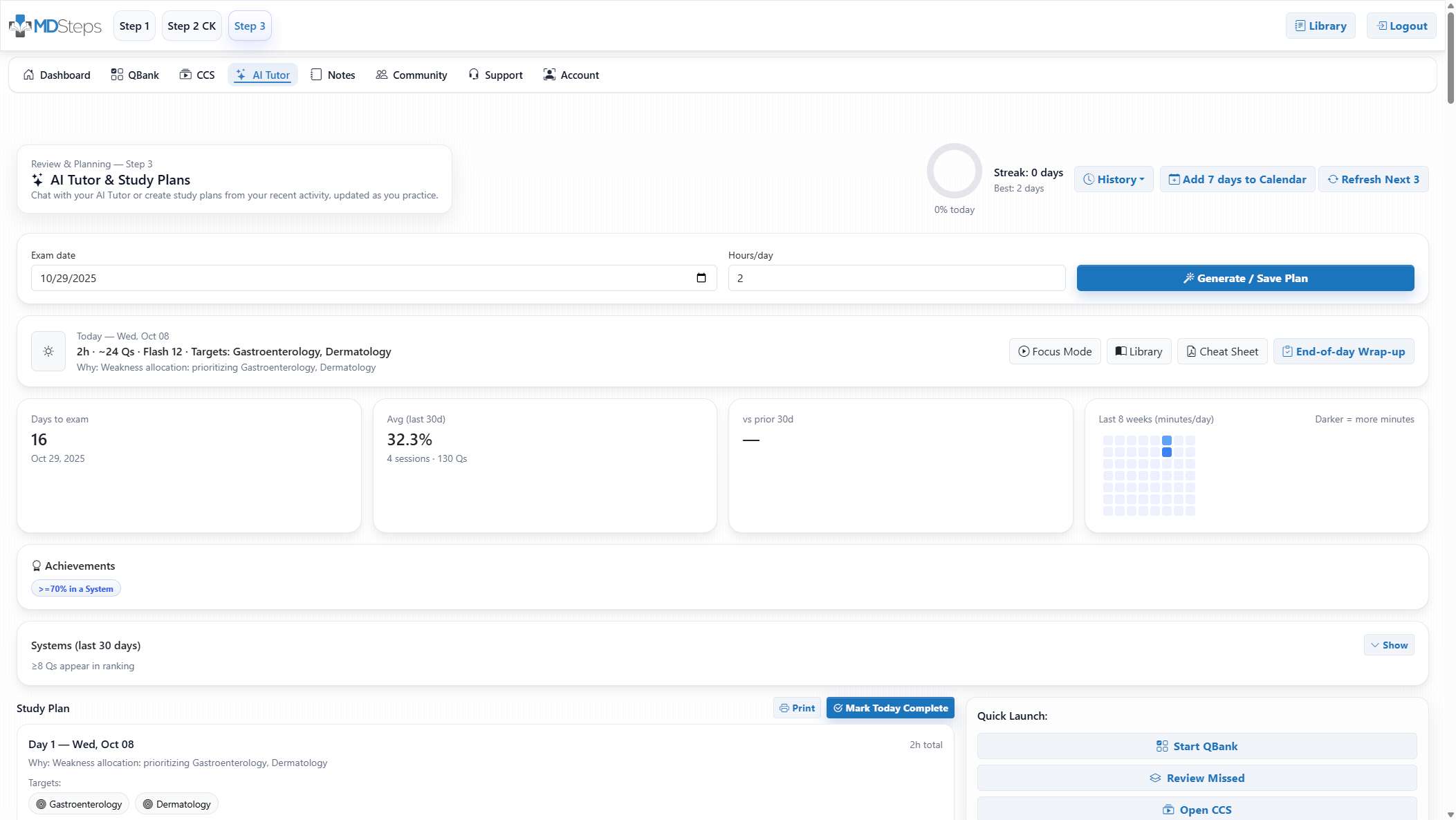
Study around real life
A Step 2 CK study plan has to survive rotations.
Step 2 prep often happens between clinic, wards, shelves, call days, and burnout. MDSteps helps turn irregular study time into focused review without losing the bigger CK picture.
- Prioritize weak specialties and recent miss patterns.
- Build short targeted sessions for busy days and longer mixed blocks for lighter days.
- Keep shelf prep connected to CK readiness.
- Use missed-step flashcards to prevent the same management errors from repeating.
Step 2 CK questions
Common questions from students trying to raise Step 2 CK scores.
Is Step 2 CK mostly diagnosis or management?
Is MDSteps a replacement for UWorld or a supplement?
How many questions should I do during rotations?
Will this help with shelf exams?
Do you include ethics, communication, and patient safety?
Are CCS cases included?
What happens if I try it and it is not useful?
Free Step 2 CK reasoning diagnostic
Find the next-step pattern holding your score back.
Try a diagnostic-style Step 2 reasoning path before committing to another paid resource. See whether your misses are coming from stabilization, disposition, test/treat sequence, ethics, or 50/50 trap answers.
- 16,000+ USMLE-style questions across Steps 1–3
- Step 2 CK next-best-step and management practice
- Depth-on-Demand™ explanations and why-wrong logic
- Analytics, auto-flashcards, and targeted review
- 135 CCS cases included for Step 3 later