USMLE® Step 3
USMLE Step 3 prep for busy doctors who need MCQs and CCS to feel manageable.
If you are studying between shifts, worried about CCS cases, or unsure how much Step 3 QBank review you actually need, MDSteps helps you practice the two things USMLE Step 3 rewards: safe clinical decisions and efficient order sequencing.
Full access is $27/month and includes the Step 3 QBank, 175 interactive Step 3 CCS cases, Step 1 and Step 2 CK review, Depth-on-Demand™ explanations, live CCS timelines, analytics, auto-flashcards, and study planning.
What USMLE Step 3 feels like when you are short on time
- You are balancing residency, call, family, or work while trying to study.
- You are not sure how many CCS cases are enough.
- You know what should happen clinically, but forget key orders under time pressure.
- You are worried about advancing the clock, reassessing, and closing cases safely.
- You need MCQ practice without buying separate tools for every part of Step 3.
Free Step 3 + CCS diagnostic
Before you buy another Step 3 resource, find out what is actually weak.
Step 3 problems usually fall into two buckets: MCQ management judgment and CCS execution. The free diagnostic path helps you see whether your issue is next-step reasoning, first orders, reassessment timing, unsafe sequencing, or case closure.
CCS page path
Need CCS first?
Send high-intent Step 3 visitors straight to the dedicated CCS page where they can run demo cases, see the simulator, and understand how the case engine works.
- Interactive demo CCS cases
- Timed order flow and after-action review
- Clearer proof for CCS-specific buyers
Common Step 3 pain points
Step 3 prep falls apart when CCS becomes a checklist and MCQs feel like random leftovers.
USMLE Step 3 is about managing patients over time. That means orders, reassessment, disposition, prevention, follow-up, and safety — in both MCQs and CCS.
“I do not have time to study.”
Residents and busy graduates need short, high-yield sessions. MDSteps helps balance MCQs and CCS around the time you actually have.
“I keep forgetting orders.”
CCS is not just knowing the diagnosis. It is remembering stabilization, monitoring, labs, imaging, meds, consults, and follow-up.
“I do not know when to advance time.”
Timing is part of the skill. MDSteps helps you practice ordering, reassessing, advancing time, and responding to changes.
“I need CCS cases that behave like patients.”
Static checklists miss the point. MDSteps CCS cases include live vitals, evolving labs, timed orders, and timeline feedback.
“I am not sure whether to focus on Step 3 MCQs or CCS.”
Most students need both. MDSteps includes Step 3 MCQs plus CCS cases so your practice does not feel split across tools.
“I am afraid of unsafe orders.”
We emphasize stabilization, contraindications, escalation, and disposition so the case review teaches safety, not just completion.
How MDSteps helps
Turn Step 3 anxiety into a patient-care workflow.
USMLE Step 3 is not just recall. It asks whether you can manage patients safely over time — in MCQs and in CCS. MDSteps connects each common Step 3 problem to the workflow you need to practice next.
You know the diagnosis, but freeze on the first orders.
CCS rewards early stabilization, monitoring, diagnostics, empiric therapy, and safe sequencing — not just naming the condition.
A first-orders workflow you can repeat.
Practice ABCs, monitoring, IV access, oxygen, fluids, labs, imaging, medications, consults, and disposition inside timed CCS cases.
You place orders, then forget to reassess.
Many Step 3 CCS mistakes happen after the first orders: the clock advances, the patient changes, and the next move gets missed.
Live vitals, evolving labs, and timeline feedback.
Vitals, labs, urine output, imaging, and clinical status change as the case progresses, so you learn to respond instead of just checking boxes.
You split CCS and MCQ practice across too many tools.
Step 3 MCQs and CCS both test management judgment: outpatient care, prevention, safety, escalation, and follow-up.
Step 3 QBank + 175 CCS cases in one subscription.
Use Step 3 MCQ blocks and interactive CCS cases together, with analytics, flashcards, and study planning included for $27/month.
You finish a case but do not know what cost points.
Without feedback, it is hard to tell whether the issue was timing, missed monitoring, unsafe therapy, delayed escalation, or incomplete closure.
After-action review that teaches the next case.
See what helped, what hurt, what came late, what was missed, and which management pattern you should practice again.
Most CCS practice feels like memorizing a list. MDSteps is built to feel like managing a patient.
Run cases with timed orders, evolving physiology, labs, imaging, consult-style updates, deterioration, recovery, and focused feedback.
The Step 3 workflow
A repeatable Step 3 CCS workflow you can take into test day.
The best Step 3 CCS practice teaches you to keep moving: stabilize, order, reassess, advance time, and close safely.
Stabilize first
Start with ABCs, monitoring, IV access, fluids, oxygen, pain control, and immediate safety needs.
Order with purpose
Choose labs, imaging, medications, consults, and procedures that match the clinical priority.
Reassess and advance time
Watch vitals, labs, symptoms, and response to therapy change as the case evolves.
Close safely
Add counseling, prevention, follow-up, disposition, and long-term management when appropriate.
See the difference
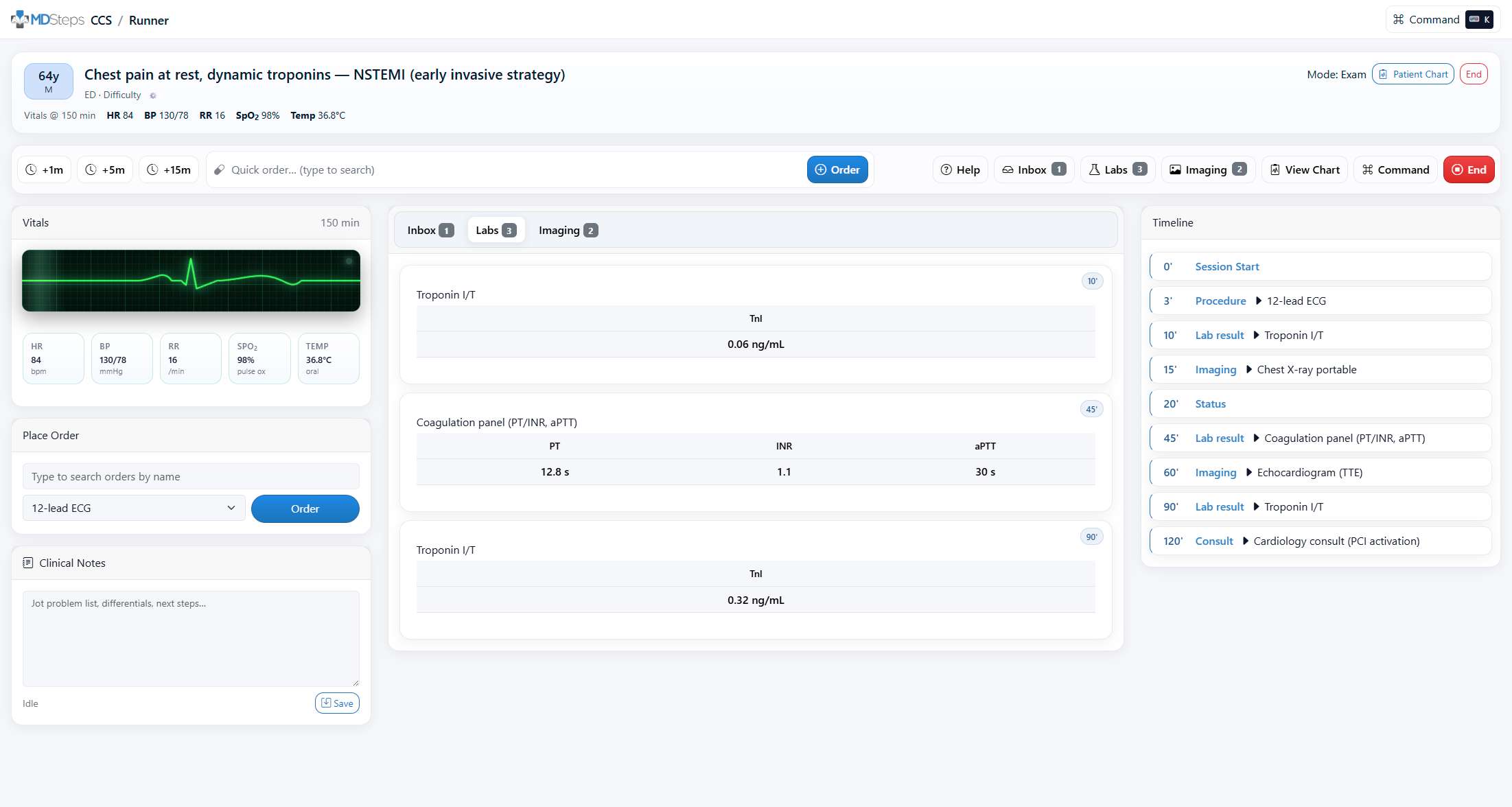
Step 3 CCS practice should teach you what happens after you order.
USMLE Step 3 CCS is not just “select the right orders.” It is a timeline. The patient changes, labs return, vitals respond, and your next move matters.
- Live vitals and timeline progression.
- Order sequencing and stabilization logic.
- Reassessment after fluids, antibiotics, pressors, procedures, and consults.
- Outcome review so you can see what changed the case.
Step 3 coverage
USMLE Step 3 is MCQs plus CCS — and both reward safe management.
MDSteps helps you prepare across Step 3 MCQs and CCS workflows: outpatient care, inpatient care, emergency decisions, prevention, chronic disease management, and safe follow-up.
Clinical content
- Internal Medicine, Surgery, Pediatrics, OB/GYN, Psychiatry, Neurology, Emergency Medicine, and Family Medicine.
- Ambulatory care, prevention, screening, counseling, chronic disease management, and follow-up.
- Inpatient and emergency management: stabilization, diagnostic strategy, treatment, escalation, and disposition.
- Ethics, patient safety, quality improvement, biostats, prognosis, and systems-based practice.
CCS competencies
- First orders: ABCs, monitoring, access, oxygen, fluids, empiric therapy, and urgent diagnostics.
- Timeline management: advance clock, reassess, interpret results, escalate, narrow, and de-escalate.
- Medication selection, dosing, contraindications, monitoring, and complications.
- Closure: counseling, prevention, follow-up, disposition, and long-term management.
Step 3 features
Everything is aimed at safe, timed Step 3 management.
Not just case volume. Step 3 practice that teaches the patient-care loop.
Dedicated CCS practice
Some Step 3 visitors do not need more persuasion. They need CCS practice now.
The Step 3 page should keep the broader MCQ + CCS story, but CCS-ready visitors deserve a direct path to the CCS cases page. That page is the better proof asset for runnable demos, simulator details, order timing, and case-review mechanics.
- Run demo cases: let visitors feel the order flow before asking for full access.
- Show timing mechanics: orders, time advance, reassessment, and closure.
- Prove feedback quality: after-action review, late orders, missed steps, and safety issues.
How MDSteps fits your prep
Use MDSteps for Step 3 CCS practice, Step 3 MCQs, or both.
Many students use MDSteps because they want interactive CCS cases, Step 3 QBank practice, and management review in one lower-cost subscription.
| What you need | Common problem | How MDSteps helps |
|---|---|---|
| CCS case volume | Students do not know how many cases are enough or whether they are improving. | Practice 175 CCS cases with timeline and outcome review. |
| Order sequencing | Knowing the diagnosis does not automatically produce safe first orders. | Train first orders, reassessment, time advance, escalation, and closure. |
| Step 3 MCQs | MCQs feel like Step 2 again, but with more long-term management and outpatient care. | Practice Step 3-style MCQs with management reasoning and why-wrong explanations. |
| Busy schedule | Residency or work makes daily study inconsistent. | Use short CCS sessions, targeted blocks, and a study plan that fits limited time. |
Study around real life
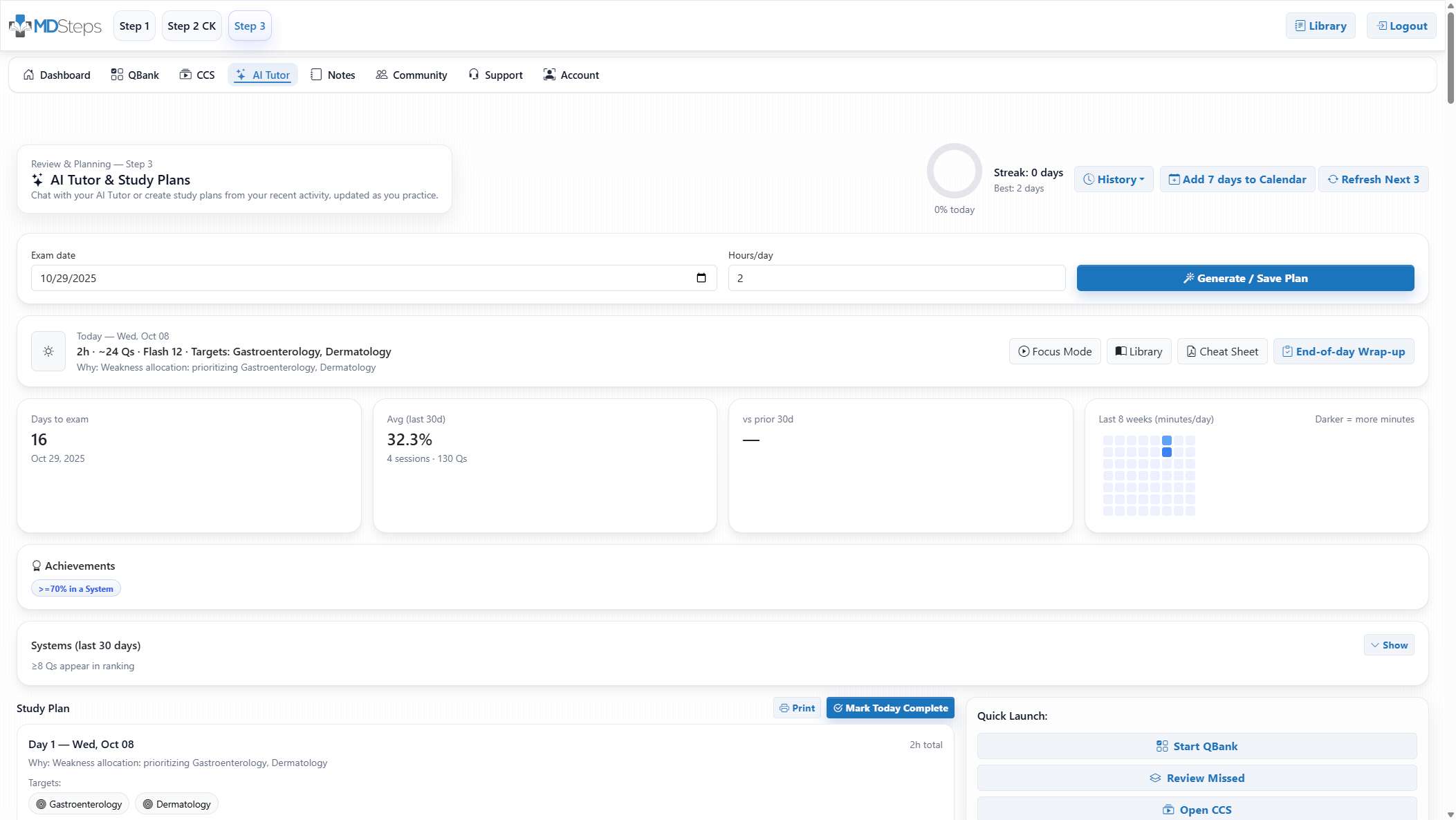
A Step 3 study plan has to fit the schedule you actually have.
USMLE Step 3 prep often happens between shifts, call, clinic, family, and exhaustion. MDSteps helps you balance short MCQ blocks, timed CCS cases, and review so you are not guessing what to do next.
- Balance MCQ blocks with CCS cases based on your timeline.
- Prioritize safety-critical and repeatedly missed management themes.
- Use short sessions for busy days and timed CCS runs for dedicated study windows.
- Turn unsafe or delayed orders into focused review.
Step 3 questions
Common questions from busy Step 3 students.
How many CCS cases should I practice before Step 3?
Does MDSteps include both MCQs and CCS?
Is this useful if I am a resident with limited time?
Do the CCS cases have evolving vitals and labs?
What makes Step 3 MCQs different from Step 2?
Can I use MDSteps as a CCSCases alternative or supplement?
What happens if I try it and it is not useful?
Start Step 3 with clearer feedback
Practice Step 3 CCS until the workflow feels familiar.
Use 135 interactive Step 3 CCS cases, Step 3 QBank blocks, timeline review, timed orders, evolving vitals/labs, and analytics to make exam day feel less unfamiliar.
- 175 interactive Step 3 CCS cases
- Step 3 QBank blocks and management review
- Live vitals, evolving labs, timed orders, timelines, and order feedback
- Depth-on-Demand™ explanations and why-wrong logic
- Analytics, auto-flashcards, and targeted review