Use timed orders, evolving vitals/labs, scorecards, and reasoning-focused review to train the exact CCS workflow: stabilize, order, reassess, advance time, and close safely. Cancel anytime. First month protected by our 7-day good-faith refund guarantee after 100 questions or 5 CCS cases. USMLE Step 3 CCS cases simulate a living patient whose vitals respond to your decisions. The exam rewards clinical judgment under time pressure, not encyclopedic recall. Your goal is to apply first principles: stabilize ABCs, identify the most probable diagnosis by risk and prevalence, and issue high-value orders that change outcomes. Every click should reflect a defensible clinical rationale. Think in two loops: a stabilization loop (airway, breathing, circulation, temperature, pain, glucose) and a diagnostic-therapeutic loop (rule out danger, confirm likely, treat early). Cases may be acute (minutes matter), subacute (hours), or chronic (days to months). Mastering tempo is essential: you’ll “advance clock” purposefully after key orders to harvest information or confirm response. MDSteps supports this mindset with live-vitals interactive CCS cases, timed orders, and an analytics dashboard to map your order timing against outcome curves. Practice translates faster when feedback is kinetic, not static. Every CCS encounter follows a rhythm. Use a simple three-phase playbook: Initial 60 seconds (stabilize + monitor), First block (focused diagnostics + empiric therapy when indicated), and Control phase (reassess, de-escalate/escalate, disposition). Tether clock advances to milestones (e.g., labs sent, antibiotics started, imaging ordered with transport time considered). Use MDSteps’ timed-order simulator to practice advancing the clock only after you’ve placed monitoring and the first wave of orders. The analytics heatmap shows where you lose minutes (e.g., imaging queued before fluids in sepsis). Be deliberate: a 30-second pause to think can save five minutes of cleanup. Practice live cases where timing, reassessment, stabilization, order value, and closure matter. MDSteps helps you see what was missed, late, unsafe, unnecessary, or done in the wrong sequence. CCS rewards structured hypothesis testing. Start broad enough to not miss killers, then pivot fast as new data arrives. Translate symptom clusters to dangerous vs common pathways, and let vitals and risk factors set pre-test probabilities. Order tests that can reclassify risk—prefer “change-management” results over curiosity labs. In MDSteps’ Adaptive QBank, explanations highlight which orders have the highest decision yield in similar presentations. Export missed concepts to Anki via automatic decks to build durable recognition of “can’t miss” patterns. Not all orders score equally. Prioritize interventions that stabilize physiology, confirm the working diagnosis, and prevent complications. Use nursing, monitoring, and counseling orders to capture “hidden” points. Avoid pan-culture/pan-scan behavior unless the presentation is undifferentiated and unstable. Practice with MDSteps’ live vitals to see how fluid boluses, oxygen, or antibiotics shift the trajectory. The platform’s readiness dashboard correlates your order timing with outcome proxies to target specific micro-skills. Clock control is the CCS superpower. You earn points by advancing time to observe effects after you have placed appropriate orders; you lose both time and points by advancing prematurely or stalling after stabilization. Build a mental map of turnaround times (e.g., CXR minutes, CT hours, cultures days) and advance in purposeful hops aligned to expected availability. MDSteps’ timer mirrors exam pacing; the case timeline view marks your advances, letting you replay decisions and spot idle segments. The goal is short, frequent, purposeful advances—not a single leap that bypasses actionable inflection points. Scoring emphasizes the appropriateness, timing, and completeness of care. You’re rewarded for ordering high-value interventions early, choosing the correct setting, monitoring, and closure tasks (follow-up, counseling). Penalties accrue for harmful delays, unnecessary invasive testing, or inappropriate disposition. Use MDSteps’ analytics to flag where you chronically leak points (e.g., missing DVT prophylaxis). The study planner then schedules targeted CCS drills and surfaces your missed patterns as flashcards you can export to Anki. Templates reduce cognitive load and speed early moves. Below is a compact set you can adapt on the fly. The point isn’t to script; it’s to ensure consistent safety steps while you personalize diagnostics. Convert these into MDSteps case checklists within the simulator to practice smooth execution. Over time, templates sharpen intuition rather than replace it. Blend spaced practice, retrieval, and simulation. Use short, frequent CCS reps with feedback rather than marathon sessions. Aim for 1–2 interactive cases daily plus targeted retrieval of weak domains. Let the MDSteps study planner adapt to your availability; it automatically assigns CCS scenarios tied to your analytics profile, preventing “all-strengths” study sessions that feel good but don’t move scores. For final polish, run two mixed MDSteps CCS Cases 3–5 days before the exam and review the analytics “missed opportunities” panel to script tomorrow’s fixes. External reading: See USMLE official site for general exam policies and structure.What USMLE Step 3 CCS Cases Actually Test (and Why Strategy Beats Memorization)
Practice 135 CCS cases plus Step 3 QBank for $27/month.
Exam-Day Promise
Where Points Hide
Time and Case Management: A Playbook for Each Phase
Phase Actions Advance Time? Scoring Rationale Initial 60s ABCs, O2, IV access, monitor, glucose, analgesia No (until monitoring active) Early stabilization and safety capture foundational points First Block Targeted labs/imaging, risk-stratified empiric therapy Yes (to obtain results) Shows judgment; avoids low-value “everything” panels Control Reassess response, narrow therapy, plan disposition Yes (after each intervention) Demonstrates dynamic management and closure Stop treating CCS like a memorized order list.
Correct orders still need the right order.
Diagnostic Reasoning Under Uncertainty: From Broad Nets to Focused Spears
A Three-Question Algorithm
High-Value Orders That Move the Needle
Do First (Often)
Often Missed
Clock Control: When to Advance Time, When to Wait
A Practical Time-Advance Script

Scoring & Performance Optimization: Capture the Quiet Points
Action Why It Scores Common Pitfall Fix Early empiric antibiotics in sepsis Time-sensitive mortality reduction Waiting for culture results Draw cultures then start antibiotics; adjust later Admission level selection Safety + resource stewardship Defaulting to ward for borderline shock Use MAP/pressors/lactate to justify ICU Counseling & preventive care Comprehensiveness and patient-centeredness “Too busy” to counsel during acute care Add at control phase or discharge orders Case Templates: Reusable Skeletons for Common Presentations
Scenario First 60s High-Yield Orders Disposition Cues Chest pain (ACS vs non-ACS) O2, IV, monitor, ECG, ASA Troponins x2–3, heparin if NSTEMI risk, CXR Admit telemetry; cath timing by risk Sepsis/undifferentiated shock O2, large-bore IVs, fluids Blood cultures, broad-spectrum abx, lactate ICU if pressors or refractory hypotension AMS (altered mental status) Airway, glucose check, thiamine if malnourished CBC, BMP, tox screen, CT head if focal/signs Admit if unclear etiology or unsafe OB: 3rd-trimester bleeding ABCs, two IVs, type and cross Ultrasound, Rh status, consult OB ICU/OR if unstable; monitor fetus Study Skills: A 2–3 Week CCS-Focused Micro-Curriculum
Day Range Focus Daily Targets MDSteps Tools Days 1–5 Stabilization + clock control 2 CCS cases + 20 QBank items Live vitals; timer; Adaptive QBank Days 6–10 High-value orders per system 2 CCS cases + flashcard review Auto deck export to Anki Days 11–15 Mixed difficulty + analytics 3 CCS cases (timed) Readiness dashboard; study planner Days 16–21 Exam simulation + polish Full-length mixed blocks Simulation mode; progress trends Rapid-Review Checklist & Exam-Day Essentials
Rapid-Review Checklist
Mindset & Logistics
Downloads, Visuals & Further Reading
References
USMLE Step 3
USMLE Step 3 CCS Cases Explained: How to Practice Orders, Timing, and Scoring
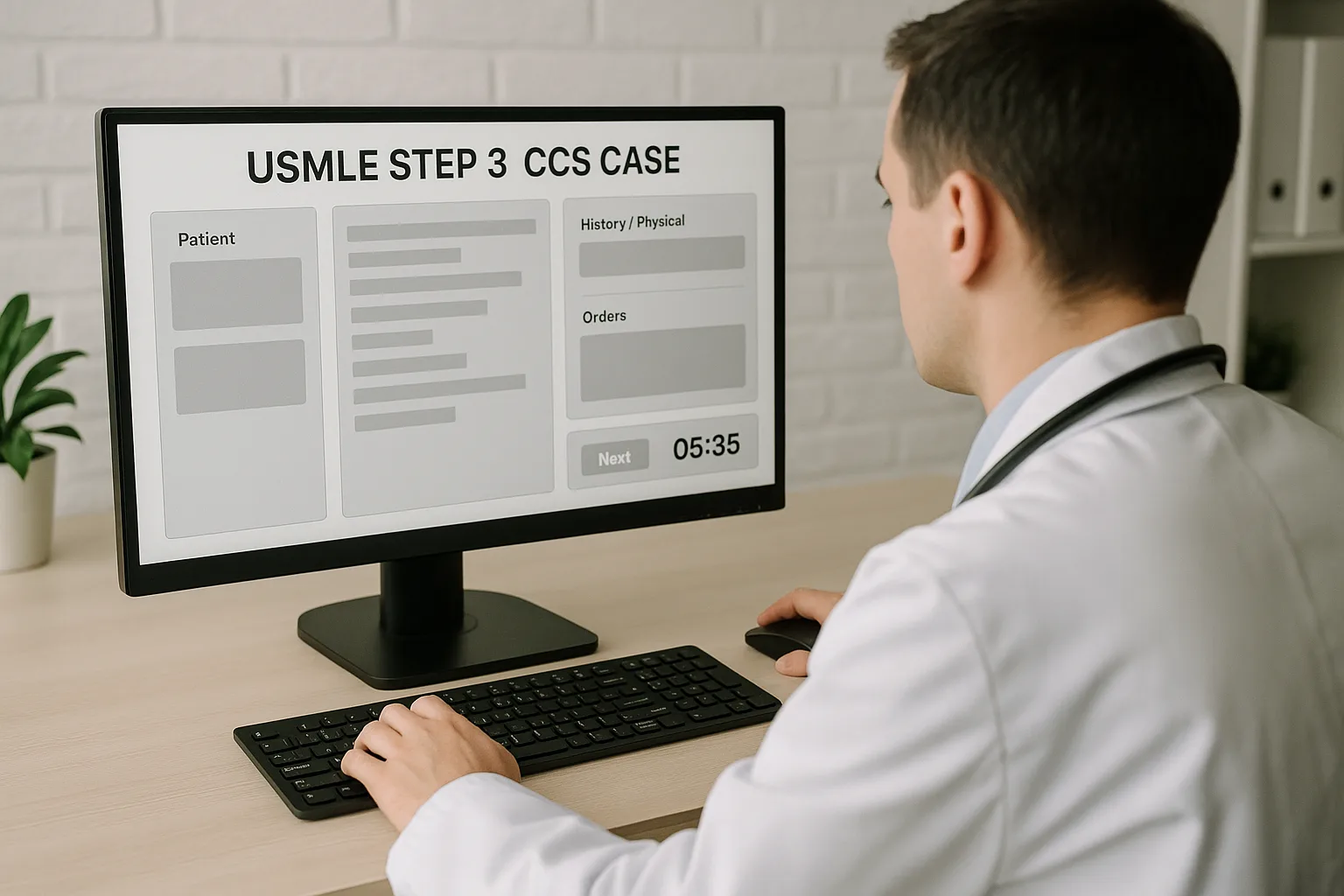
For CCS timing and order logic
CCS is not just what you order. It is when you order, reassess, and close the case.
MDSteps helps you practice live CCS cases with vitals, orders, labs, time advancement, reassessment, closure, and after-action feedback.
Full access includes Step 1, Step 2 CK, Step 3, CCS cases, analytics, auto-flashcards, and study planning.
Live case flow
Practice vitals, orders, labs, consults, treatments, and reassessment as the patient changes.
Order timing
Learn what must happen now, what can wait, and what loses value when late.
After-action feedback
See missed, late, unsafe, and unnecessary actions after each case.
MDSteps Step 3 CCS Practice
Pro tip: Create a “first 60 seconds” checklist in your head and deploy it on every case—even stable clinic scenarios. Consistency prevents misses when stakes spike.
CCS timing, orders, and reassessment
Free CCS demo cases
Live CCS case flowOrder timing reviewAfter-action feedback
Run free CCS demo cases first. Full access includes Step 3 QBank practice, CCS cases, analytics, and study planning.
CCS practice
Still missing the same kinds of questions?
Read why that happens.