Get 16,000+ USMLE-style questions, 135 CCS cases, stem decoding, visual rationales, analytics, flashcards, and reasoning-focused review in one subscription. Cancel anytime. First month protected by our 7-day good-faith refund guarantee after 100 questions or 5 CCS cases. Chest pain is one of the most frequently tested complaints on Step 2 CK and Step 3, precisely because it forces you into rapid prioritization: rule out the killers first, stabilize, risk-stratify, then streamline diagnostic testing. Over both exams, the NBME heavily rewards students who think like ED clinicians—recognizing red flags, interpreting initial data points correctly, and knowing when a finding does not change management. The ED evaluation follows a strict hierarchy: identify immediate threats (ACS, PE, dissection, tension pneumothorax, tamponade, esophageal rupture), determine stability, acquire essential diagnostics early, and apply validated clinical tools only when safe. Step questions often hinge on knowing when to rely on these tools (e.g., HEART score, Wells, PERC) versus when to bypass them entirely due to instability or exam “danger cues.” Several distractors appear repeatedly: ordering a stress test during active pain, waiting for troponin trends when ST-elevation is present, or deferring aspirin until after imaging. Your goal in every vignette is to recognize which action changes outcomes immediately—and to act on it. Likewise, many cases use borderline findings such as atypical radiation, mild tachycardia, or nonclassic risk factors to make you reconsider premature closure. The algorithm below will anchor your thinking for every chest pain presentation. Applying this sequence consistently enhances your accuracy in both emergency medicine vignettes and outpatient follow-up scenarios, since the ED pathway determines subsequent management. The first rule of the ED chest pain workup algorithm: treat physiology before diagnostics. Step 2 CK and Step 3 repeatedly test your ability to identify instability early. If the vignette uses phrases like “diaphoretic,” “ashen,” “obtunded,” “severe respiratory distress,” “SBP < 90,” or “gasping,” you must stabilize before considering any formal testing. NBME trick: a patient with chest pain and severe dyspnea who is “rapidly deteriorating” should receive stabilization before ECG or CXR—even if ACS is suspected. Management steps always follow the pattern taught by ACLS. Once stabilized, immediate tests in every chest pain vignette include: An early aspirin is universally correct unless contraindicated. Step 3 frequently tests whether you recognize that aspirin comes before troponin results or cardiology consultation. Many examinees mistakenly delay this intervention—resulting in missed points. If this article gave you a pathway, MDSteps helps you practice the exact moment where the stem changes the next test, diagnosis, or management step. Acute coronary syndrome accounts for the highest-stakes decisions during chest pain evaluation. The NBME expects you to rapidly differentiate STEMI from NSTEMI and unstable angina based on ECG clues and symptom evolution. STEMI: New ST-elevation in ≥2 contiguous leads or posterior ST depression + tall R waves. Immediate reperfusion is the only acceptable next step. The exam may allow fibrinolysis if PCI is unavailable within guideline windows. NSTEMI: Troponin elevation without ST elevation. Management includes anticoagulation, dual antiplatelet therapy, and risk-guided invasive strategy. Watch for “refractory angina” or “hemodynamic instability”—both mandate urgent catheterization. Unstable angina: Symptoms consistent with ACS but normal troponins. Treat similarly to NSTEMI until proven otherwise. MDSteps’ Adaptive QBank helps reinforce ACS decision-making by surfacing variants of these scenarios, including posterior MI recognition, left main equivalents, and high-risk NSTEMI presentations. Because the QBank adjusts difficulty based on your misses, you repeatedly practice the exact reasoning required to master the ED chest pain workup algorithm. After ACS is evaluated, your next priority is excluding the remaining life-threatening causes. The NBME uses structured cues to signal each condition. First-line test: CT angiography (if stable).
If unstable → bedside TEE is preferred. Do not apply PERC or Wells if unstable. Straight to CT pulmonary angiography or empiric anticoagulation if shock persists. Clinical diagnosis only. Needle decompression precedes imaging. Beck triad: hypotension, JVD, muffled heart sounds.
First-line test: bedside echo.
Treatment: emergent pericardiocentesis. Severe chest pain after vomiting, with subcutaneous emphysema.
First-line test: CT chest with contrast or fluoroscopic esophagram. The exams test your ability to choose the correct imaging pathway based on stability and suspicion level. Memorizing this table saves enormous time: Step 3 questions commonly require you to choose management before confirmatory imaging if the condition is clinically obvious. This tests whether you prioritize stabilization over diagnostics. Troponin interpretation is a subtler challenge on both exams. You must differentiate acute MI from chronic elevation and understand the timing of release and clearance. NBME trick: If a patient has classic ischemic symptoms + ischemic ECG changes, treat as ACS even before troponins return. MDSteps’ automatic flashcard generator (exportable to Anki) reinforces these patterns by turning your troponin-related QBank errors into spaced repetition cards—a powerful way to internalize the kinetics and avoid mistakes on test day. The HEART score, Wells criteria, Geneva score, and PERC rule all appear in Step 2 CK/3 vignettes, but the exams emphasize knowing when these tools are appropriate. NBME distractor: offering a risk score when the patient is in clear distress or when symptoms strongly suggest a dangerous diagnosis. Always bypass scoring tools in these situations. Mastering this algorithm dramatically improves accuracy across Step 2 CK and Step 3 emergency medicine blocks. For full-length practice, consider MDSteps’ Adaptive QBank and exam analytics dashboard, which present chest pain cases in escalating complexity and help you monitor readiness with objective performance metrics. Medically reviewed by: Jordan Hale, MD, FACEPStudy Step 1, Step 2 CK, Step 3, and CCS for $27/month.
Understanding the ED Logic Behind Chest Pain Triage
Step 1: Primary Assessment & Stabilization
Stop memorizing the whole algorithm. Train the branch point.
Still missing questions you thought you understood?
Step 2: Rapid ACS Identification & First-Line Actions
Finding
STEMI
NSTEMI
Unstable Angina
ECG
ST elevation
ST depression or T-wave inversion
Normal or minimal changes
Troponins
Elevated
Elevated
Normal
Immediate Priority
Reperfuse
Antithrombotics + risk stratify
Monitor + repeat testing
Step 3: Identifying Non-ACS Life Threats
Aortic Dissection
Pulmonary Embolism
Tension Pneumothorax
Cardiac Tamponade
Esophageal Rupture
Step 4: Imaging Logic on Step 2 CK & Step 3
Suspected Condition
Stable
Unstable
PE
CTPA
Bedside echo & empiric anticoagulation
Aortic Dissection
CTA chest
TEE
Tamponade
Echo
Immediate pericardiocentesis
Pneumothorax
CXR
Needle decompression
Step 5: Cardiac Biomarkers & Troponin Interpretation
Step 6: Risk Stratification Tools—When to Use & When Not To
Rapid-Review Checklist: ED Chest Pain Workup Algorithm
References
Algorithms & Diagnostics
Chest Pain on Step 2 CK & Step 3: The Ultimate ED Workup Algorithm
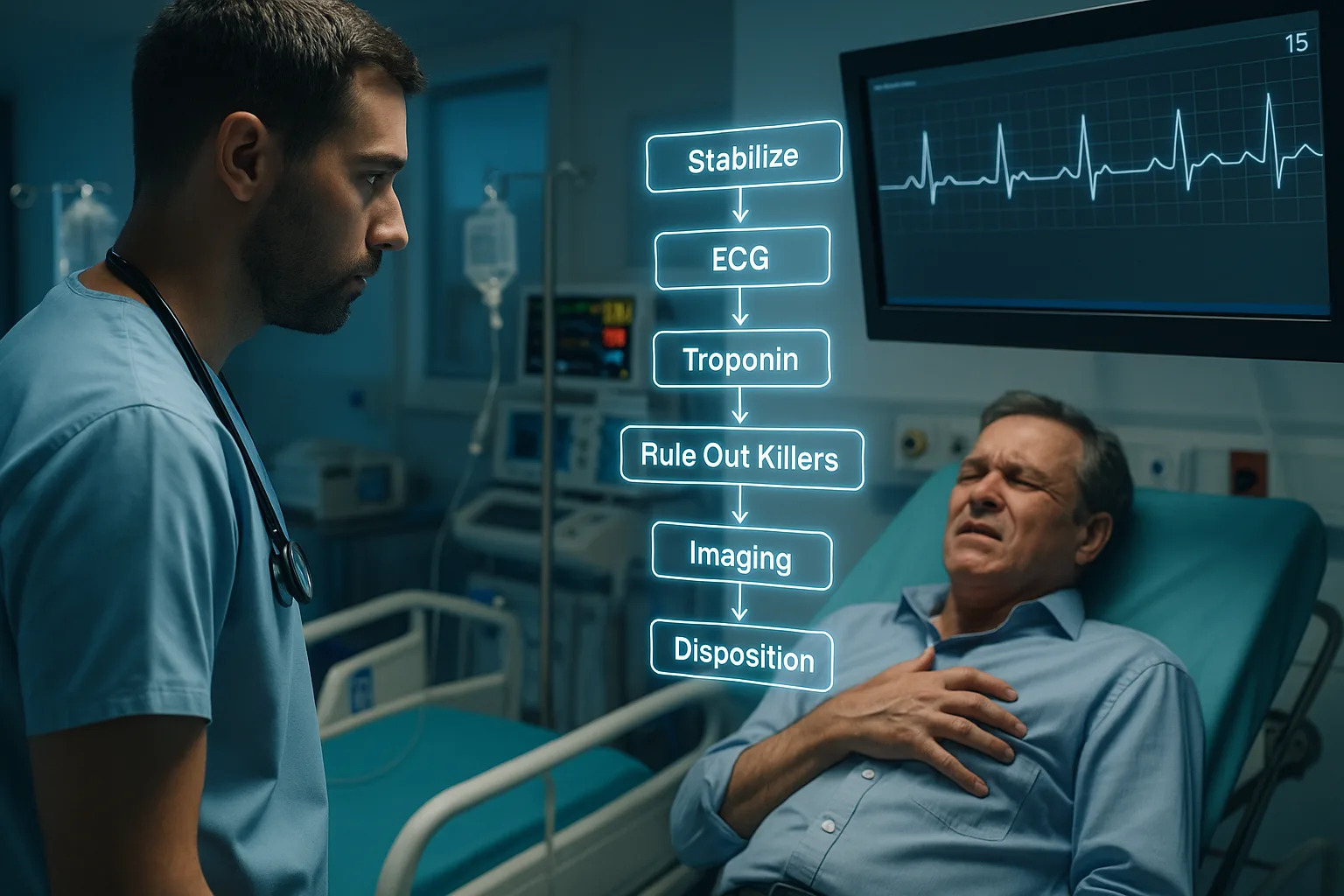
For algorithm and diagnostic uncertainty
The exam rarely asks for the whole flowchart. It asks for the next branch.
MDSteps trains the clue that changes the next test, rules out the tempting workup, or makes one diagnosis more likely than another.
Full access includes Step 1, Step 2 CK, Step 3, CCS cases, analytics, auto-flashcards, and study planning.
Pivot-clue review
See the exact phrase in the stem that should have changed your decision.
Distractor trap logic
Learn why the answer you almost picked felt right—and why it was wrong for this patient right now.
Miss-pattern analytics
Turn repeated mistakes into targeted blocks, flashcards, and readiness signals.
MDSteps Full Access
Score stuck after more questions?
Free reasoning diagnostic
Pivot clue isolatedDistractor trap explainedNext study target identified
No credit card required for the free reasoning review. Full access is $27/month after that. Cancel anytime.
Reasoning diagnostic
Still missing the same kinds of questions?
Read why that happens.