The biggest mistake after a Step 1 pass is treating Step 2 CK like “Step 1 with more facts.” Step 2 is a decision exam. The question stem may contain pathophysiology, but the scoring hinge is usually the next best step: stabilize first, choose the highest-yield test, start empiric therapy when indicated, or select the disposition that prevents harm. In the first 30 days, your job is to rebuild your habits around clinical reasoning and workflow, not to reread every system.
Think in three layers. Layer 1 is immediate safety: airway, breathing, circulation, and time-sensitive threats (sepsis, acute coronary syndrome, stroke, ectopic pregnancy, testicular torsion). Layer 2 is probability and pretest logic: which diagnosis is most likely from the vignette, and what single test changes management. Layer 3 is guideline-driven management: first-line therapies, contraindications, and follow-up. If your daily studying consistently touches all three layers, your curve steepens quickly.
The first month should be “system building.” You need a schedule you can follow on bad days, a question bank workflow you can repeat without friction, and a method to capture misses into durable memory. Once those systems are stable, adding hours becomes optional. The most effective Step 2 students win on consistency, not heroics.
Practically, that means your default study unit is a question set, not a chapter. Content review supports question performance, not the other way around. You will still learn medicine, but you learn it in the format the exam uses: short vignettes, ambiguous distractors, and management forks.
Use this on every vignette for 30 days until it is automatic.
If you want this as a built-in habit, MDSteps users often pair timed blocks with an automatic miss-to-flashcard pipeline so the same error does not recur.
A baseline in the first week is not about predicting your final score. It is about identifying your top three bottlenecks early so you stop wasting time. Most Step 2 setbacks come from one of four issues: weak test-taking process, weak management algorithms, poor review loop (you forget your misses), or inconsistent daily volume. Your baseline should be built to diagnose these, not to produce an ego number.
Your first 80 questions should produce a clear pattern. If your misses are mostly algorithm and management, you need a “next best step” playbook and repetition. If your misses are recall-heavy, you need an aggressive spaced repetition loop and targeted content. If timing is a problem, your intervention is not “more content,” it is a reading and decision routine.
This is where most learners leak points. They read the explanation, nod, and move on. Step 2 rewards decision automation. Your review must force you to generate the decision, not merely recognize it. If you do that from day one, your improvement is fast and durable.
The goal for month one is to establish a repeatable cadence: question blocks, structured review, and a small amount of targeted content to patch recurring gaps. A common trap is overplanning. Step 2 plans fail when they require perfect days. Build a plan with a “floor” and a “ceiling.” The floor is what you do no matter what. The ceiling is what you do when your day is clean.
If you are in clerkships, your ceiling may be lower and your floor is the real game. Even 40 questions daily with disciplined review compounds quickly. If you are in dedicated, use the ceiling more often but keep the floor sacred. Consistency drives retention.
MDSteps turns your article takeaway into daily targets, weak-area review, and measurable progress instead of another static calendar.
For Step 2, the question bank is both content and skill training. The fastest route to improvement is not “more explanations,” it is higher-quality iterations: timed blocks, decisive answering, and structured review that produces durable rules. The purpose of month one is to create a loop you can keep for months.
Your review should prioritize the decision point. Ask: “What would have made this easy in real clinic?” Often it is a single discriminator: the presence of hypotension, a pregnancy test, focal neuro deficit, fever plus neck stiffness, or a classic medication adverse effect. Step 2 writers love “almost correct” options that are correct later in the algorithm. Your job is to identify where in the timeline you are.
Targeted sets are tools, not a lifestyle.
If you have access to MDSteps, this is the stage where an adaptive QBank can be helpful because it can push more items from your weakness list while keeping mixed exposure. Pair that with an exam-readiness dashboard so you can see whether your errors are improving by category (recognition, algorithm, or recall) rather than only tracking percent correct.
Content review matters, but month one is not the time for a comprehensive textbook march. Your highest ROI comes from short, targeted patches that directly address repeat misses. The goal is to convert vague knowledge into a usable rule that survives time pressure.
Use a “3:1 ratio” as a default: for every three units of time spent doing questions plus review, spend one unit on content patching. The patch should be narrow. Instead of “cardiology,” patch “unstable angina vs NSTEMI initial management,” “new murmur plus fever workup,” or “AF rate control contraindications.” This keeps your review aligned with exam decisions.
A useful structure is the “one-page patch.” After you miss an algorithm twice, build a single page that includes: (1) the trigger vignette, (2) the first two steps in management, (3) a contraindication list, and (4) a “do not do this” trap. Keep these patches in a small binder or a digital note system. Revisit them every three to four days for two weeks, then weekly.
Avoid passive rewatching. If you use videos or reading, do it with a question in mind: “What would make me choose option B over option C?” Then immediately reinforce by doing 5 to 10 targeted questions. The learning happens in retrieval and correction, not in watching.
In month one, spaced repetition is a tool to prevent repeat errors, not a trophy collection. Cards should be short, decision-based, and tied to a vignette cue.
The best content review is the one that changes your next 40-question block. If it does not change your decisions within 48 hours, it was too broad or too passive.
Step 2 CK question writers reward a specific kind of thinking: prioritize threats, use discriminators, and follow standard-of-care sequences. Many learners “know the disease” but miss the step because they skip severity assessment or choose a test that does not change management. Month one is the right time to drill a reliable reasoning routine.
Train yourself to answer in order. First, name the problem. Second, assign severity. Third, choose the test or treatment that is indicated at that severity and time point. Fourth, rule out the distractor that is “true later.” Many Step 2 items are timeline puzzles: options are all things you might do, but only one is correct now.
NOW (do first) LATER (after stabilization or confirmation)
Over time, you should notice your accuracy improving even before your content “feels” complete. That is a sign your decision process is becoming stable, which is exactly what this exam rewards.
In the first month, many learners overshoot and burn out. Step 2 prep is a longer runway than Step 1 for most students because it often overlaps with clerkships, call, and real clinical fatigue. Your plan must be robust to bad days. That means a floor, a recovery strategy, and a way to measure progress without spiraling.
Do this even on post-call days. Use this when the schedule is clean.
Treat sleep as a study tool. Memory consolidation and decision speed both suffer when sleep is inconsistent. If you are trading sleep for late-night passive review, you are usually losing points. A realistic target is stable bedtime and wake time most days, with one flexible night per week. Protecting sleep also protects your ability to do timed blocks, which are the engine of improvement.
If you want to automate the boring parts, this is also where an automatic study plan generator can help keep your floor and ceiling realistic across clerkship weeks, and where an analytics dashboard can highlight whether your misses are improving by category rather than relying on gut feeling.
By day 30, you should not expect mastery of every topic. You should expect a stable workflow, improved decision-making, and fewer preventable mistakes. Your checkpoint is a timed mixed block (or two) under exam-like conditions, followed by an honest review of your miss taxonomy. The goal is to confirm that your errors are moving from “process failures” toward “content depth,” which is a healthier place to be.
Daily Weekly
If you complete month one with a stable workflow and honest tracking of repeat misses, month two becomes straightforward: increase mixed volume, keep patches narrow, and add periodic self-assessments when your schedule permits. The first 30 days are the foundation that makes the rest efficient.
Medically reviewed by: Priya Shah, MD, Internal Medicine ReferencesReset your framework: Step 1 thinking to Step 2 decision-making
Step 2 mindset shifts to adopt this week
Clinical reasoning “micro-algorithm”
Days 1 to 3: Baseline diagnostics without derailing your momentum
Baseline checklist (do this in 72 hours)
Miss taxonomy (what actually went wrong?)
How to review one question like a Step 2 clinician
Your first 30 days schedule: a realistic weekly cadence
Week
Primary focus
Daily targets (floor → ceiling)
End-of-week deliverable
Week 1
Days 1–7Baseline + workflow setup (timing, review loop, miss log)
Top 3 weakness list + “next-step” cheat sheet started
Week 2
Days 8–14Management algorithms (ED triage, antibiotics, OB emergencies, cardio)
One-page “stabilize-first” list (sepsis, ACS, stroke, GI bleed)
Week 3
Days 15–21High-yield inpatient medicine + imaging and labs interpretation
“When to CT vs US vs MRI” decision notes + common lab patterns
Week 4
Days 22–30Integration + pacing (timed blocks, mixed sets, fewer pauses)
Retake a timed mixed block and compare miss taxonomy
A sample weekday template
A sample weekend template
A study schedule only works if it changes with your performance.
Still missing questions you thought you understood?
QBank-first strategy: how to turn questions into clinical competence
Rules for every block in the first month
Common Step 2 traps (and the fix)
When to do targeted sets
Content review in month one: minimal, targeted, and immediately applied
High-yield month-one patch topics
Spaced repetition: keep it small, keep it sharp
Build NBME-style reasoning: how to choose the “next best step” reliably
Five discriminators that decide many questions
Common management sequences to memorize
A practical “now vs later” method
Protect your endurance: pacing, sleep, and a plan that survives real life
The “floor”
The “standard day”
The “ceiling”
Progress metrics that do not lie
Day 30 checkpoint and rapid-review checklist
Day 30 audit: what you should be able to answer
If your progress is slower than expected
Rapid-Review Checklist: first 30 days essentials
Study Schedules
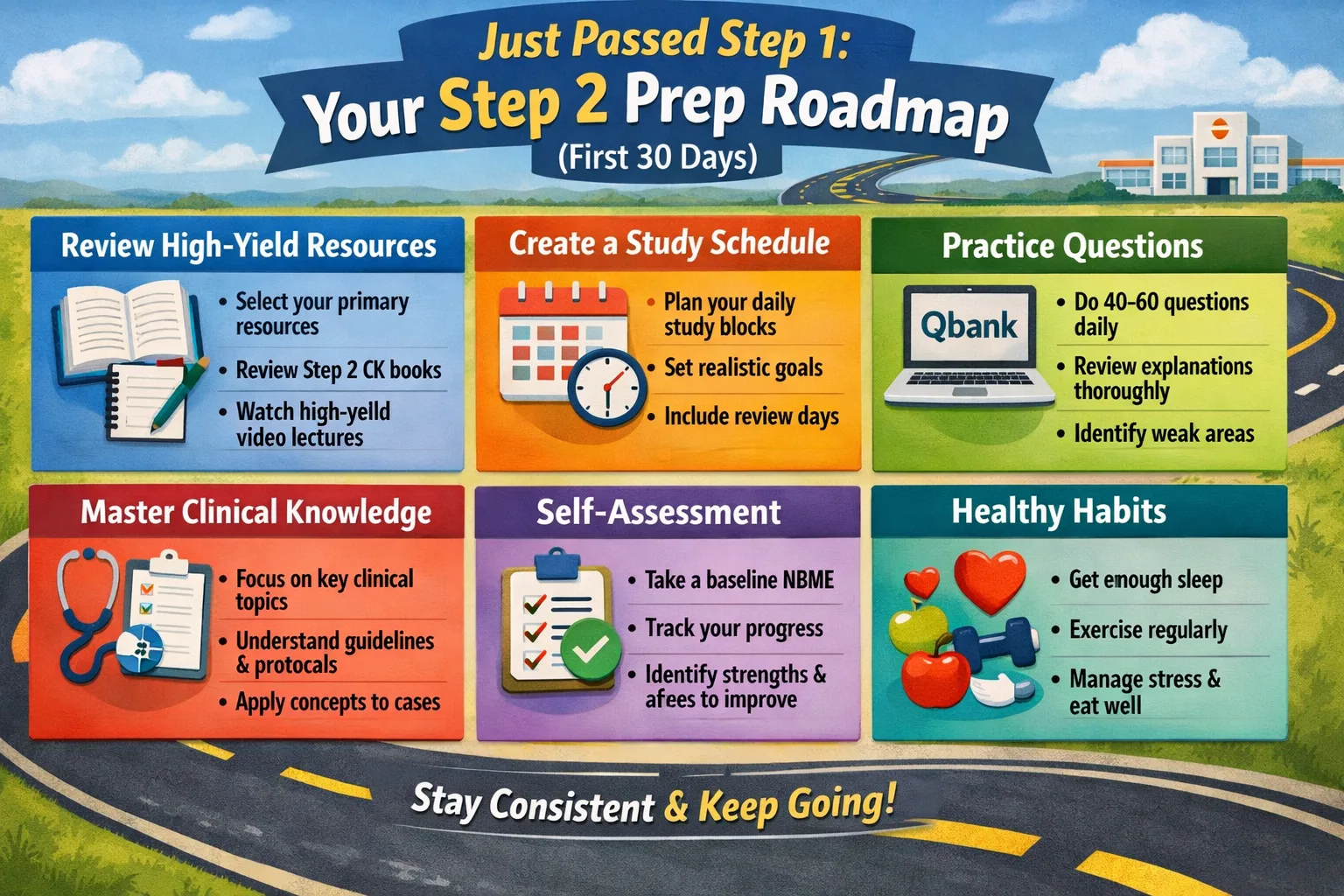
Just Passed Step 1? Here's Your Step 2 Prep Roadmap (first 30 days).
For study plans that need feedback
A pretty calendar is not the same as a feedback loop.
Use question performance, weak-area analytics, missed-question review, and daily targets to decide what each study day should fix.
Full access includes Step 1, Step 2 CK, Step 3, CCS cases, analytics, auto-flashcards, and study planning.
Pivot-clue review
See the exact phrase in the stem that should have changed your decision.
Distractor trap logic
Learn why the answer you almost picked felt right—and why it was wrong for this patient right now.
Miss-pattern analytics
Turn repeated mistakes into targeted blocks, flashcards, and readiness signals.
1) Stabilize now? (ABCs, shock, altered mental status)
↓
2) Syndrome label (one phrase)
↓
3) Best discriminator (one test or step)
↓
4) Treat/disposition (first-line, empiric when indicated)
↓
5) Follow-up + prevention (vaccines, screening, counseling)
Score stuck after more questions?
Free reasoning diagnostic
Pivot clue isolatedDistractor trap explainedNext study target identified
No credit card required for the free reasoning review. Full access is $27/month after that. Cancel anytime.
Reasoning diagnostic
Still missing the same kinds of questions?
Read why that happens.