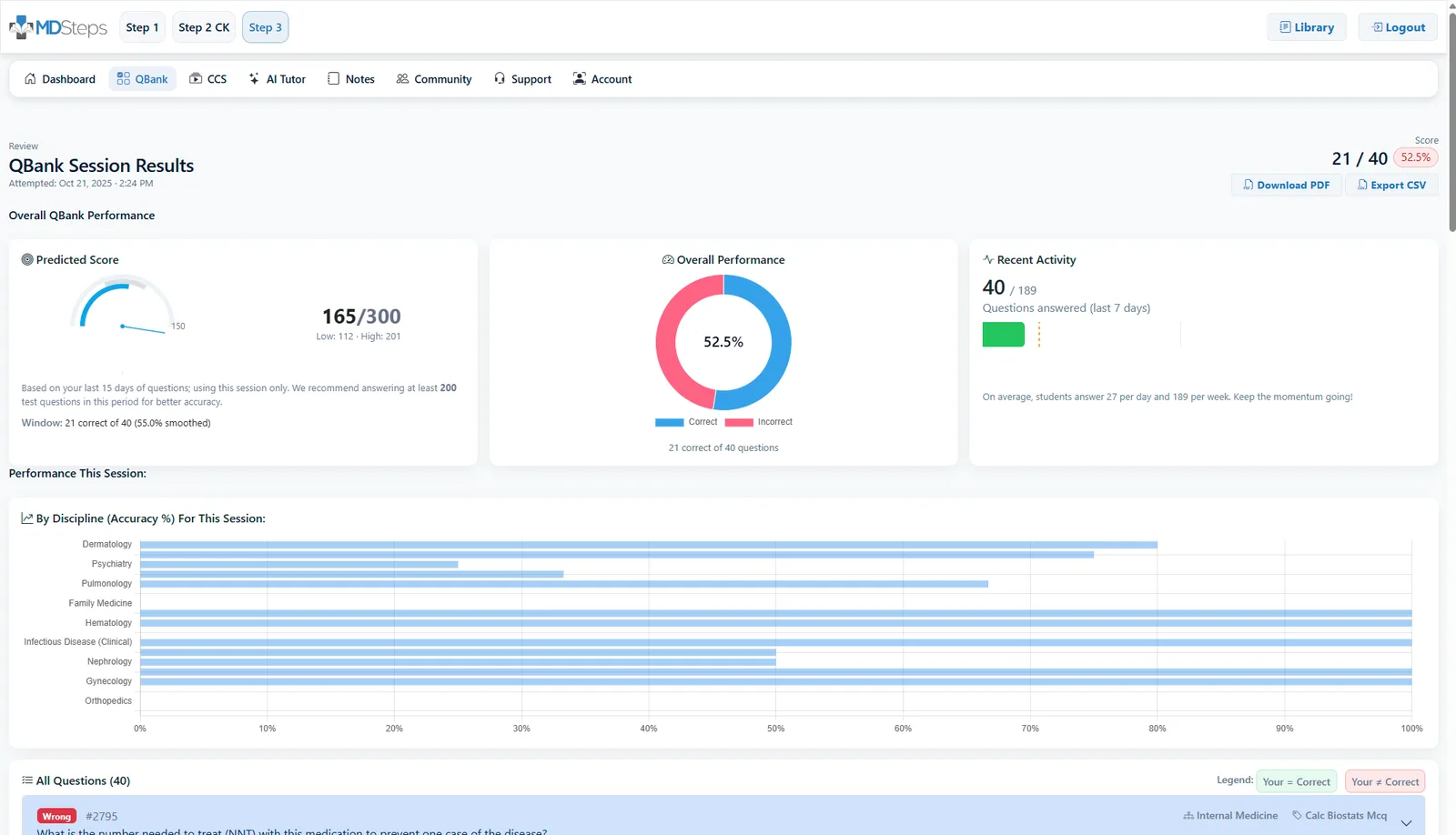
A Step 2 CK study plan below 220 must do more than add hours. It must diagnose why clinical reasoning is leaking points, rebuild decision patterns, and convert every missed question into a repeatable rule for the next vignette. A student starting below 220 usually has one of four problems. The first is knowledge incompleteness, where core clerkship facts are missing. The second is recognition without retrieval, where explanations feel familiar but the student cannot reproduce the diagnosis or next step under timed pressure. The third is poor illness-script discrimination, where several answer choices sound plausible because the student has not learned the small features that separate look-alike diseases. The fourth is testing behavior, where pacing, anchoring, premature closure, or fear of changing answers lowers performance despite adequate content knowledge. The first week should identify which problem is dominant. A low score does not automatically mean the student needs to reread a book. Many students below 220 have already watched enough videos and read enough explanations. Their limiting factor is that they cannot convert a patient presentation into a clinical action. Step 2 CK rewards supervised patient-care reasoning. It emphasizes diagnosis, management, prevention, interpretation of labs, risk factors, prognosis, ethics, safety, and communication. A useful plan therefore treats the exam as a clinical decision test, not a trivia test. Begin with a full-length or near full-length diagnostic using an official-style self-assessment, then review it by error type. Do not only record the organ system. A wrong cardiology item caused by misreading “best initial test” is not the same weakness as a wrong cardiology item caused by not knowing acute coronary syndrome management. Use a spreadsheet or notebook with five columns: diagnosis missed, clue ignored, wrong decision made, correct rule, and review date. This transforms review from passive explanation reading into a personal error curriculum. For a student below 220, the target is not perfection in every subject. The target is to stop losing predictable points. The highest return areas are medicine, obstetrics and gynecology, pediatrics, surgery, psychiatry, biostatistics, ethics, quality improvement, and screening. Within each area, prioritize presentations that appear repeatedly across clerkship exams: chest pain, dyspnea, syncope, abdominal pain, altered mental status, fever, vaginal bleeding, pregnancy complications, pediatric rashes, trauma, electrolyte abnormalities, and preventive-care visits. These are not separate lists to memorize. They are recurring clinical scripts. The study calendar should be score-based. A student at 205 with six weeks needs a different plan than a student at 218 with three weeks. Still, the sequence is similar: diagnose weakness, rebuild core scripts, do mixed timed questions, review misses aggressively, then transition to self-assessment guided polishing. Students should avoid the common mistake of delaying mixed blocks until they “finish content.” The exam does not present nephrology after a nephrology chapter. It mixes specialties, ages, acuity, and task type. Mixed practice is uncomfortable because it exposes uncertainty, but that discomfort is the training effect. Use official USMLE sample materials early enough to learn the interface and question style. For exams beginning on or after May 7, 2026, the Step 2 CK testing experience uses shorter 30-minute blocks, so stamina practice should include rapid re-entry into focused decision-making after frequent block transitions. Older advice based only on eight long blocks may still teach endurance, but it does not fully reflect the newer rhythm. Students preparing around the transition should verify the current format directly from USMLE before test day. Use one baseline self-assessment and classify misses by reasoning failure. Build illness scripts and rules from repeated misses, not from vague “weak topics.” Retest with timed mixed blocks and NBME-style assessments before scheduling risk. The psychological reset matters. A score below 220 is data, not a diagnosis of ability. The useful interpretation is: “My current system is not producing reliable clinical decisions yet.” That framing leads to action. It also protects students from changing resources every three days. The plan should be strict enough to provide structure and flexible enough to adapt after every assessment. A baseline map is the difference between studying hard and studying the right material. After the first self-assessment or 120 to 160 mixed QBank questions, classify each miss into a pattern. Do not write “OB weak” or “renal weak.” Those labels are too broad to guide behavior. Write “confused preeclampsia without severe features with gestational hypertension,” “missed septic arthritis because fever was absent,” or “picked CT before stabilizing an unstable trauma patient.” Specific labels create specific fixes. Use five error buckets. Bucket one is content gap: the student did not know the disease, guideline concept, mechanism, screening recommendation, or medication adverse effect. Bucket two is clue weighting: the student saw the clue but did not know it was decisive. Bucket three is task mismatch: the student identified the diagnosis but answered the wrong clinical task, such as best next step, most likely diagnosis, risk factor, complication, or initial management. Bucket four is distractor attraction: the student chose a familiar but less correct answer. Bucket five is execution: timing, careless reading, answer changing without evidence, or fatigue. This system prevents overcorrection. A missed pulmonary embolism item does not always require two hours of pulmonary review. If the real issue was failing to notice postpartum status and pleuritic chest pain, the repair is a vignette clue rule. If the issue was not knowing when to use CT pulmonary angiography, ventilation-perfusion scanning, or empiric anticoagulation, the repair is an algorithm. If the issue was reading too fast and missing hypotension, the repair is a pacing checklist. The same topic can require different interventions. The best review question is, “What would make me get the next version right?” The answer should fit on one flashcard, one line of a notebook, or one table cell. Avoid copying long explanations. Long copied notes feel productive, but they rarely change performance. A useful note is retrieval ready: “Pregnant patient with suspected appendicitis: ultrasound first; MRI if nondiagnostic; avoid CT unless necessary.” It is short, conditional, and tied to a patient context. Students below 220 often also underuse correct answers. A correct answer chosen for the wrong reason is a hidden weakness. During review, mark any question that felt like a guess even if it was correct. These “lucky corrects” should enter the same review system as incorrects, because the exam will test the same idea in a less forgiving form. A rising score comes from converting both incorrects and guesses into reliable scripts. A baseline map also tells you which resources to use. If many misses are from forgetting facts, flashcards and targeted review are needed. If many misses are from task mismatch, more explanations will not fix the problem unless the student practices identifying the question command. If many misses are from distractors, the student should spend more time on why tempting options are wrong. The goal is to replace resource accumulation with repair matching. The MDSteps Step 2 CK platform can help at this stage when used deliberately. Its adaptive QBank, automatic study plan generator, analytics dashboard, and flashcard decks from missed questions are most useful when the student labels misses honestly. The tool should not become another passive content feed. It should function as a diagnostic engine that tells the student where the next hour should go. A practical plan for students starting below 220 usually needs four to eight weeks. Six weeks is a useful middle framework because it allows enough time for diagnosis, repair, mixed practice, and repeated self-assessment. If a student has fewer weeks, compress the same sequence rather than skipping the diagnostic step. If a student has more weeks, extend the question volume and spaced review, but do not stretch passive content indefinitely. Week 1 is baseline and triage. Complete a self-assessment or a large mixed sample, then review it over two days. Build the error map. Begin daily timed mixed blocks, even if the score feels discouraging. Add targeted content only after the block review identifies a need. The week should end with a written top-10 weakness list, ranked by frequency and fixability. “Fixability” matters because not every weakness deserves equal time. If one topic is rare and another appears repeatedly across medicine, surgery, pediatrics, and obstetrics, the repeated topic wins. Weeks 2 and 3 are core repair. The student should do one to two timed mixed blocks per day, followed by deep review. Add focused mini-sessions for the most common weaknesses: hypertension in pregnancy, diabetes complications, chest pain algorithms, abdominal emergencies, pediatric fever, anticoagulation, anemia, nephritic versus nephrotic patterns, psychiatric safety, ethics, and quality improvement. Each mini-session should end with retrieval, not rereading. Close the resource and write the algorithm from memory. Then test it with questions. Week 4 is integration. Increase mixed timed work and reduce long content sessions. Start practicing transitions between organ systems and task types. Review NBME-style self-assessment errors in detail. If the score remains below the target trajectory, diagnose whether the issue is content volume or decision process. A student who knows explanations but keeps choosing second-best answers needs contrast practice. A student who cannot explain the correct answer after review needs content repair. A student who runs out of time needs a block system. Week 5 is exam simulation. Complete another self-assessment under strict conditions. Review it within 24 to 48 hours. Build a “final 200 rules” document from repeated mistakes. This is not a new textbook. It is a short list of facts and decisions that have personally cost points. Do not add rules that have never appeared in your misses unless they are high-yield safety issues. The final document should include action verbs: stabilize, intubate, give fluids, obtain pregnancy test, order ultrasound, start antibiotics, isolate, report, reassure, screen, counsel, or operate. Week 6 is consolidation and readiness verification. Continue timed mixed questions, but avoid exhausting marathons that impair review quality. Use spaced recall for the final rules. Practice USMLE sample questions and the interface. Sleep and timing become academic tools at this stage. A tired student who adds 200 low-quality questions may learn less than a rested student who reviews 80 questions with precision. The schedule must be adjusted for clinical rotations. A student on a demanding rotation may use a “minimum effective day”: 40 timed questions, review of incorrects, and 20 minutes of spaced recall. A student on a lighter block may complete two blocks and a longer targeted session. The minimum day prevents all-or-nothing thinking. Missing one full study day should not become missing a week. If you keep narrowing stems to two answers and picking the distractor, the problem may not be your medical knowledge. MDSteps shows the pivot clue, the trap answer, and the reasoning pattern behind the miss—then turns it into targeted practice. Question review is where most score gains are either created or lost. Students below 220 often review explanations as if they are reading a chapter. They understand the answer in the moment, feel reassured, and move on. The problem appears two weeks later when a similar patient presentation triggers the same wrong choice. Review must therefore produce a rule, a contrast, or a behavioral change. Use a three-pass review. Pass one is the decision audit. Before reading the explanation, write why you picked your answer and what feature made you uncertain. This is important because explanations can erase your original thinking. Once you read the official or QBank explanation, you may falsely believe you “almost knew it.” The written audit preserves the actual error. Pass two is the clinical rule. Ask what the exam wanted you to do. Was it asking for diagnosis, initial test, confirmatory test, treatment, prevention, risk factor, prognosis, or complication? Step 2 CK frequently tests the same disease through different tasks. A student may know that a patient has ectopic pregnancy but miss whether the next step is transvaginal ultrasound, methotrexate, laparoscopy, or Rh immune globulin. The question task controls the answer. Pass three is the contrast. Write why the closest wrong answer was wrong. This is the highest-yield part of review for students near 220 because many misses are not from total ignorance. They are from choosing a second-best answer. Examples include choosing MRI before stabilizing a patient, antibiotics before cultures when the patient is stable, colonoscopy during acute diverticulitis, or reassurance when a red flag requires workup. The exam rewards order and priority. Clinical reasoning improves when students build “if this, then that” scripts. A script should include patient type, key clues, dangerous alternatives, initial action, and common trap. For example: “Older patient with jaw claudication, temporal headache, and vision symptoms: treat suspected giant cell arteritis immediately with glucocorticoids, then confirm with biopsy or imaging. Do not wait for biopsy if vision is threatened.” This script is compact and action oriented. For diagnosis questions, build discriminators. Do not memorize every feature of every disease in isolation. Compare diseases that appear together in answer choices: bacterial vaginosis, candidiasis, and trichomoniasis; ulcerative colitis and Crohn disease; nephritic and nephrotic syndromes; DKA and HHS; SIADH and cerebral salt wasting; panic disorder and hyperthyroidism; bronchiolitis and asthma; preeclampsia and chronic hypertension. The point is not to make a beautiful table. The point is to learn the two or three clues that decide the item. Do not overbuild flashcards. A flashcard should test a decision, not store a paragraph. Poor card: “Preeclampsia explanation.” Better card: “Pregnant patient after 20 weeks with BP elevation and severe headache. Next step?” The answer should include severe features and treatment logic. If the card requires a long explanation, split it into separate cards for diagnosis, severe features, magnesium sulfate, antihypertensive therapy, delivery timing, and postpartum risk. Review should also include correct questions that took too long. A student who spends four minutes on a question and gets it right has still found a weakness. The repair may be faster script recognition. During the final weeks, speed comes from clarity, not from rushing. Students who rush without better scripts simply make faster errors. A student starting below 220 cannot treat every fact equally. The best use of time is to prioritize domains that appear frequently, integrate across clerkships, and affect patient safety. Internal medicine is the largest foundation, but Step 2 CK is not a medicine-only test. Obstetrics, pediatrics, surgery, psychiatry, emergency care, ethics, communication, and quality improvement can each raise a score when reviewed through clinical tasks. Begin with acute presentations. These teach the exam’s priority logic: stabilize first, identify life threats, choose the best initial test, and start urgent treatment when delay is dangerous. Chest pain requires distinguishing myocardial infarction, pulmonary embolism, aortic dissection, pericarditis, pneumothorax, and esophageal causes. Dyspnea requires sorting asthma, COPD, heart failure, pneumonia, pulmonary embolism, anemia, and anxiety. Abdominal pain requires attention to age, pregnancy status, location, peritoneal signs, vascular risk, fever, and hemodynamic stability. Next, review obstetrics because it is algorithmic and point dense. Students should know first trimester bleeding, ectopic pregnancy, spontaneous abortion categories, Rh prophylaxis, preeclampsia spectrum, HELLP syndrome, gestational diabetes screening, fetal heart rate interpretation, postpartum hemorrhage, shoulder dystocia, and postpartum infection. The exam often tests timing. “Before 20 weeks” and “after 20 weeks” are not decorative details. They change the differential and management. Pediatrics should be learned by age, immunization status, fever pattern, development, and hydration. A neonate with fever is not managed like a vaccinated school-age child. A toddler with barking cough differs from a child with drooling and tripod positioning. A teenager with weight loss, polyuria, and abdominal pain requires different thinking than a toddler with vomiting and lethargy. Age is a diagnostic clue, not background information. Surgery and emergency medicine require sequence discipline. Many students miss surgical questions because they choose the correct definitive treatment at the wrong time. Unstable patients need resuscitation and urgent management. Stable patients often need imaging. Trauma questions frequently hinge on airway, breathing, circulation, focused assessment with sonography in trauma, CT in stable patients, and operative indications. Acute abdomen questions hinge on peritonitis, obstruction, ischemia, pregnancy, and immune status. Psychiatry and ethics are score opportunities because the correct answer often follows a principle. For psychiatry, know safety first: suicidal ideation, homicidal ideation, psychosis, intoxication, withdrawal, delirium, and capacity. For ethics, prioritize autonomy, informed consent, confidentiality, capacity assessment, surrogate decision-making, and nonjudgmental communication. Avoid answer choices that are punitive, dismissive, deceptive, or that skip consent when the patient has capacity. Biostatistics and epidemiology should be practiced with calculations and interpretation, not memorized passively. Students should be able to distinguish incidence and prevalence, sensitivity and specificity, positive predictive value and negative predictive value, relative risk and odds ratio, confidence intervals, p values, bias types, screening test tradeoffs, and intention-to-treat analysis. These questions are often winnable with a small set of rules. Use integrated practice. If a question involves a pregnant patient with dyspnea, it belongs to obstetrics, pulmonary medicine, and emergency care at the same time. This is why isolated reading has limited transfer. The exam tests clinical overlap. A strong plan repeatedly exposes the student to overlap until the first thought becomes, “What is the safest next decision for this patient?” Score recovery depends on remembering decisions under pressure. Rereading explanations creates familiarity, but Step 2 CK requires retrieval. A student must recall the rule before the answer choices pull attention toward distractors. This is why spaced retrieval should run every day. It does not replace questions. It makes question review durable. Use a simple schedule: same day, 48 hours, one week, and two weeks. When you miss a question, create a short rule or flashcard. Review it later the same day, then two days later, then one week later. If it remains difficult, keep it active. If it becomes automatic and has appeared in multiple mixed blocks, retire it or reduce the frequency. The goal is not to collect thousands of cards. The goal is to repeatedly retrieve the rules that have personally caused errors. Retrieval should be active. Cover the answer and produce the diagnosis, test, treatment, or next step. Say the answer aloud or write it. Then check. If you only read the front and nod, you are training recognition, not retrieval. For clinical algorithms, use blank-page recall. For example, write the management of suspected pulmonary embolism from memory, including stability, pretest probability, D-dimer, CT pulmonary angiography, V/Q scan considerations, and anticoagulation. Then compare with your source. Interleaving is also essential. Do not review all cardiology cards, then all renal cards, then all obstetrics cards every day. Mix them. Mixed retrieval feels harder because each card requires you to identify the category before answering. That is exactly what the exam requires. A patient with fatigue may have anemia, depression, hypothyroidism, pregnancy, malignancy, chronic kidney disease, or medication adverse effects. The first task is not recalling a fact. It is sorting the clinical frame. Spaced retrieval also protects against the illusion of mastery. Students often feel confident immediately after reading an explanation. The better test is whether they can answer a related question three days later with no prompt. If not, the explanation was understood but not retained. The system should catch this before the exam does. Use flashcards selectively for facts and decision points. Good cards include screening intervals, vaccine contraindications, medication adverse effects, diagnostic thresholds, classic complications, and first-line management. Poor cards include entire QBank paragraphs, rare facts without clinical context, or cards that ask, “What is everything about disease X?” Cards should be fast, specific, and clinically framed. The MDSteps automatic flashcard deck from missed questions can be useful here because it shortens the distance between error and review. Its value is highest when students edit cards into their own decision language and export mature decks to Anki when that workflow fits their routine. The adaptive QBank with more than 9000 questions should be used to generate repeated retrieval opportunities, not to chase volume without reflection. Identify the exact clinical rule that failed. Write one short retrieval prompt. Review at 48 hours, 1 week, and 2 weeks. Confirm the rule in a mixed timed block. Students should reserve a fixed daily retrieval window. Twenty to forty minutes is enough when cards are well written. The window should not expand until it consumes question time. If the review queue becomes unmanageable, the cards are too broad or too numerous. Delete low-value cards and keep rules that prevent repeated misses. Self-assessments are decision tools. They are not moral judgments. A student below 220 should use them to answer three questions: Is the score improving, which domains remain weak, and is test day reasonable? The wrong approach is to take many assessments close together without enough repair time. That creates anxiety and burns valuable forms. The right approach is to place assessments after meaningful study intervals, then review them with more seriousness than ordinary blocks. Use an official-style baseline near the beginning. Take another assessment after two to three weeks of structured repair. Take a final assessment close enough to guide the decision but far enough to allow final adjustments. The exact timing depends on the test date, but the principle is stable: every assessment should change the plan. If it does not change the plan, the student is using it only for reassurance. When reviewing an assessment, categorize every miss by task. Many students discover that they are not uniformly weak. They may miss prevention, quality improvement, obstetric timing, pediatric fever, or management after diagnosis. Task-based patterns are more actionable than subject-based patterns. A student who misses “best next step” questions across subjects needs priority training. A student who misses “most likely diagnosis” questions needs illness-script discrimination. A student who misses “risk factor” questions needs epidemiology and pathophysiology review. Score interpretation should be conservative. Day-to-day performance varies. A single good block does not prove readiness, and a single bad block does not erase progress. Look for trend, consistency, and explanation quality. A student is moving toward readiness when timed mixed blocks become more stable, incorrects are explainable, repeated misses decline, and self-assessment scores approach or exceed the desired safety margin. For students aiming to move above 220, the first goal is consistent passing margin and reduced volatility. For students aiming higher, the next goal is reducing second-best answer errors. The most common plateau occurs when students know enough to narrow to two choices but lack the task precision to choose the best one. This plateau is broken by reviewing wrong answer logic, not by doing random extra content. Test timing should also reflect the current exam interface. USMLE materials note the use of shorter blocks for examinees testing on or after May 7, 2026. Students should practice with the current interactive materials and understand break structure before test day. A student who only practices one long block style may be surprised by a different cadence. The knowledge tested is clinical, but the delivery format still affects pacing and mental reset. Do not ignore red flags. If multiple assessments remain below the desired passing margin, if timing is uncontrolled, or if the student cannot review questions accurately because of fatigue or anxiety, more questions alone may not solve the issue. The plan may need postponement, schedule reduction, coaching, or targeted remediation. The decision should be made with data, not hope. The final week should be calm, structured, and familiar. It is not the time to change the entire resource stack, start a massive new deck, or chase obscure facts. The goal is to protect recall, sharpen timing, and reduce preventable errors. Students starting below 220 often feel tempted to compensate with exhausting study days. That approach can backfire if it worsens sleep, attention, and confidence. Continue timed mixed questions, but reduce volume if review quality falls. Each block should still produce a small number of final rules. Review high-frequency personal misses daily. Practice brief blank-page recalls for algorithms that repeatedly appear: chest pain, dyspnea, altered mental status, hypertensive pregnancy disorders, vaginal bleeding, pediatric fever, trauma, sepsis, electrolyte emergencies, and psychiatric safety. Keep the focus on decisions. Use the official sample questions and interactive testing experience to confirm format, navigation, highlighting, strikeout, and break strategy. Students testing after the 2026 format transition should specifically practice the shorter block rhythm. This does not require panic. It requires familiarity. A block routine might include reading the last sentence first, identifying the task, scanning vitals, reading the stem, predicting the answer, then checking options. The routine should be practiced before the exam so it feels automatic. Plan breaks. The exam is long, and attention is a clinical skill. Bring acceptable snacks, hydration, identification, scheduling permit, and layers for temperature. Decide before test day how you will use breaks. Avoid using breaks to look up missed questions. That habit increases stress and cannot change submitted answers. Use breaks to reset physiology: bathroom, water, food, breathing, and posture. During questions, use priority logic. If the patient is unstable, stabilize. If the question asks for best initial test, do not choose the definitive test unless it is also the initial test. If the patient has a life-threatening condition where treatment cannot wait, treat before confirmation when guidelines and safety logic support that action. If the question is ethics or communication, choose the answer that acknowledges the patient, gathers information, respects autonomy, and avoids judgment. If stuck between two choices, return to the task and the decisive clue. Answer changing should be evidence based. Change an answer when you identify a missed clue, misread the task, or recognize a clear rule. Do not change only because another option feels familiar. Familiarity is a common distractor mechanism. Many students below 220 lose points because they talk themselves out of the correct first answer without new evidence. The most important final-week question is, “What can still change my score?” The answer is usually not another broad content pass. It is reducing predictable errors: missing the task, ignoring vitals, choosing a late step before an early step, forgetting a personal rule, or losing focus after a difficult block. A strong final week protects against those errors. Students below 220 can improve when the plan is honest, active, and measured. The work is not simply more questions. It is better use of every question. Diagnose the miss, repair the rule, retrieve it later, test it under time, and adjust based on self-assessment data. That cycle is the clinical score reset. Medically reviewed by: Elena Ramirez, MD, FACPStart With the Score Problem, Not the Calendar
Build a Baseline Map From Missed Questions
Error type
What it looks like
Best repair
Retest method
Content gap
Unknown disease, test, treatment, or prevention rule
Targeted review plus 5 to 10 related questions
Flashcard and mixed block
Clue weighting
Key age, timing, exposure, or lab clue was ignored
Build an illness-script contrast table
Compare similar vignettes
Task mismatch
Diagnosis known but “next step” or “risk factor” missed
Underline the task before reading choices
Timed question stem drills
Distractor attraction
Familiar answer chosen over best answer
Write why the wrong answer is wrong
Redo missed options orally
Execution
Rushed reading, fatigue, overthinking, or answer switching
Block routine and pacing checkpoints
Timed mixed blocks only
Use a Six-Week Recovery Framework
Week
Main goal
Daily work
Output by end of week
1
Baseline and triage
Diagnostic review, 1 mixed block, error log
Top-10 weakness map
2
Core repair
1 to 2 blocks, targeted mini-sessions
First set of illness scripts
3
Clinical algorithms
Mixed blocks, next-step drills, flashcards
Management decision notebook
4
Integration
Timed blocks, NBME review, contrast tables
Updated score trajectory
5
Simulation
Self-assessment, stamina practice, rule review
Final 200 rules
6
Consolidation
Timed review, sample questions, sleep protection
Exam-day routine
Learn the patterns behind your misses. Break the plateau.
Still missing questions you thought you understood?
Convert Question Review Into Clinical Reasoning
Question Review Micro-Algorithm
Prioritize High-Yield Clinical Domains
Domain
High-yield focus
Common trap
Medicine
Chest pain, dyspnea, renal, endocrine, infection, anemia
Treating a diagnosis without considering stability
OB/GYN
Bleeding, hypertension, fetal monitoring, postpartum care
Ignoring gestational age
Pediatrics
Fever, development, dehydration, respiratory distress
Using adult logic for infants
Surgery
Trauma sequence, acute abdomen, postoperative complications
Choosing definitive treatment before stabilization
Psychiatry and ethics
Safety, capacity, consent, confidentiality, communication
Selecting a judgmental or coercive response
Make Spaced Retrieval the Daily Engine
Use Self-Assessments to Decide, Not to Panic
Readiness Signals
Final Week and Exam-Day Essentials
Rapid-Review Checklist
References
USMLE Step 2 CK
Best Step 2 CK study plan for students starting below 220

For students stuck despite doing more questions
UWorld explains the medicine. MDSteps explains the decision.
Traditional review often tells you the correct answer. MDSteps helps isolate the decision error: the missed pivot clue, the tempting distractor, the timing mistake, or the weak rule that failed under pressure.
Full access includes Step 1, Step 2 CK, Step 3, CCS cases, analytics, auto-flashcards, and study planning.
Pivot-clue review
See the exact phrase in the stem that should have changed your decision.
Distractor trap logic
Learn why the answer you almost picked felt right—and why it was wrong for this patient right now.
Miss-pattern analytics
Turn repeated mistakes into targeted blocks, flashcards, and readiness signals.
Diagnose
Repair
Verify
Score stuck after more questions?
Free reasoning diagnostic
Pivot clue isolatedDistractor trap explainedNext study target identified
No credit card required for the free reasoning review. Full access is $27/month after that. Cancel anytime.
Reasoning diagnostic
Still missing the same kinds of questions?
Read why that happens.
Miss
Condense
Space
Retest