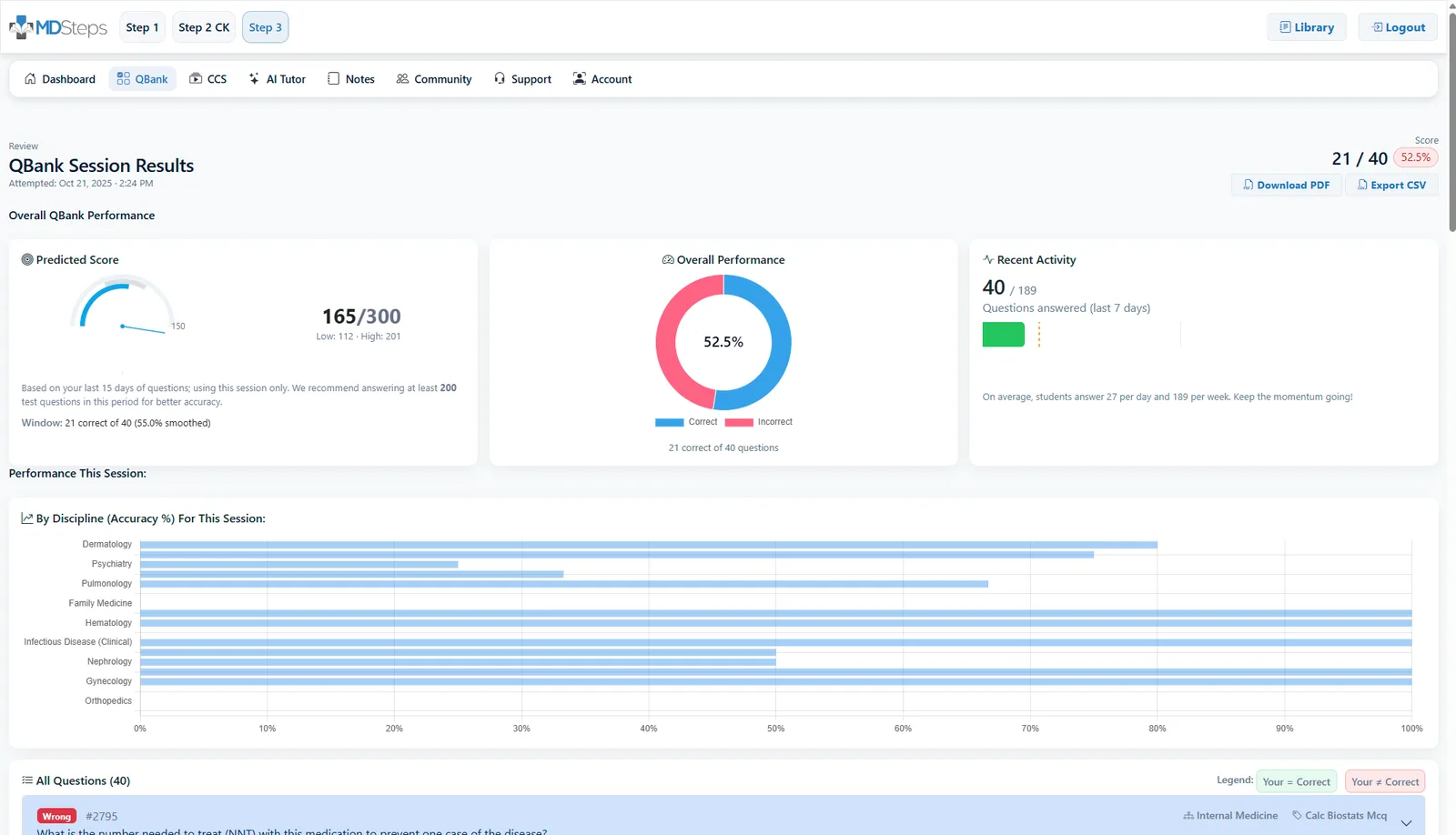
An optimized 8-week plan that balances knowledge consolidation, clinical pattern recognition, and NBME-style test simulation for Step 2 CK readiness. The Step 2 CK study schedule over eight weeks demands disciplined layering of skills—recall, reasoning, and readiness. Each two-week phase builds toward full-length practice exams that simulate real testing conditions. Week 1–2 focus on review and question pacing, Week 3–4 sharpen diagnostic logic, Week 5–6 stress clinical integration, and Weeks 7–8 center on simulation and fatigue management. Students who follow a consistent, evidence-based schedule outperform those who rely on unstructured cramming. The aim is adaptive reinforcement: revisiting weaknesses identified through QBank analytics, flashcards, and self-assessment data. Tools like MDSteps’ Adaptive QBank and automatic flashcard decks can streamline this feedback loop so no missed question goes unreviewed. Use simulation days not only for endurance but also to train judgment under pressure. Mimicking NBME timing, including break allocation, dramatically improves final-week confidence and pacing control. Each block should start with measurable objectives—“complete 1,000 Qs,” “achieve 75 % on mixed sets,” or “review missed diagnosis patterns.” Data-driven tools like the MDSteps Analytics Dashboard help visualize which disciplines need tightening before simulation days begin. A well-structured day follows the “3-Block Rule.” Each block represents a cognitive phase: active recall, applied reasoning, and targeted review. Students balancing rotations or work can adapt by splitting the first block before shifts and completing review afterward. Consistency trumps volume; 60 Q/day performed deeply outweighs 120 rushed Qs. Integrate short “recall bursts”—5-minute active recall drills between tasks—to maintain retrieval strength throughout the day. If you keep narrowing stems to two answers and picking the distractor, the problem may not be your medical knowledge. MDSteps shows the pivot clue, the trap answer, and the reasoning pattern behind the miss—then turns it into targeted practice. Designate every fifth day in Weeks 5–8 as a Simulation Day. These full-length NBME-style runs replicate exam stamina. Use the same 1-hour lunch break and 10-minute inter-block pauses. Post-exam, spend 2–3 hours reviewing cognitive errors—particularly misread stems, premature closure, and time misallocation. MDSteps’ analytics tag these automatically for you, mapping each missed item to underlying cognitive bias. Track heart rate, concentration dips, and nutrition. Step 2 CK success is not only about clinical reasoning but also performance physiology. Recognize how caffeine, hydration, and circadian rhythm affect output; adjust simulation timing to mirror your scheduled exam slot. Even the best plan fails if the student collapses mid-cycle. Incorporate at least one rest half-day weekly. Evidence supports active rest—brief exercise, social connection, and low-intensity recall rather than total disengagement. The MDSteps Planner can automatically slot recovery periods when fatigue markers rise, ensuring adaptation instead of attrition. Sleep consistency is the single highest-yield performance variable. A stable sleep-wake cycle (± 30 min) outperforms extra study hours in the final week. Treat rest as strategic conditioning for the brain’s prefrontal cortex—the seat of clinical decision-making. Every student hits plateaus around Week 4–5. The key is looped feedback. Identify weak topics by reviewing percentile drops across QBank subjects, then perform micro-reviews within 48 hours. Studies on spaced repetition show that reinforcement within 2 days of error recall doubles long-term retention. MDSteps’ flashcard auto-generator instantly creates decks from incorrect questions, ready for Anki export. Use these decks nightly for 20-minute active recall cycles, prioritizing high-miss categories. This converts passive frustration into measurable progress. The last 14 days should replicate real testing patterns. Run two full simulations (Days −12 and −6) under strict timing. Adjust question pacing to ≈ 85 seconds per item. Focus reviews on ethics, communication, and biostatistics—high-yield, low-memorization domains that often separate mid-240s from 260+ scores. Practice mental transitions between blocks. Visualization and structured breathing reduce cognitive lag. Use MDSteps’ readiness dashboard to ensure cumulative score trends meet your target zone (e.g., ≥ 75 % correct on recent mixed sets). If your variance is low and endurance stable, taper down to light recall days before the exam. This eight-week blueprint keeps preparation data-driven, sustainable, and clinically aligned—mirroring the test’s integrated reasoning core. By the final week, you’ll not only recall information but execute like a clinician under pressure. References & Further Reading:The 8-Week Framework: From Foundation to Simulation
Phase Breakdown: Two-Week Blocks That Build Mastery
Weeks Primary Focus Key Activities 1–2 Systemic Review Internal Med + Peds; 80–100 Q/day; brief recall review 3–4 Clinical Integration OB/GYN + Surgery; mixed-mode blocks; early NBME form 5–6 High-Yield Refinement Psych, Neuro, ID; rapid QBank cycles; reinforcement notes 7–8 Simulation & Strategy Full mocks every 5 days; fatigue training; flashcard sprints Daily Blueprint: Balancing Question Blocks and Review
Learn the patterns behind your misses. Break the plateau.
Still missing questions you thought you understood?
Simulation Days: Training for Endurance and Judgment
Strategic Rest and Burnout Prevention
Rapid Integration: Turning Weaknesses into Strengths
Final Two Weeks: Exam Readiness & Performance Tuning
Rapid-Review Checklist: 8-Week Execution Summary
USMLE Step 2 CK
Step 2 CK Study Schedule for 8 Weeks: Daily Blueprint & Simulation Days

For students stuck despite doing more questions
UWorld explains the medicine. MDSteps explains the decision.
Traditional review often tells you the correct answer. MDSteps helps isolate the decision error: the missed pivot clue, the tempting distractor, the timing mistake, or the weak rule that failed under pressure.
Full access includes Step 1, Step 2 CK, Step 3, CCS cases, analytics, auto-flashcards, and study planning.
Pivot-clue review
See the exact phrase in the stem that should have changed your decision.
Distractor trap logic
Learn why the answer you almost picked felt right—and why it was wrong for this patient right now.
Miss-pattern analytics
Turn repeated mistakes into targeted blocks, flashcards, and readiness signals.
Score stuck after more questions?
Free reasoning diagnostic
Pivot clue isolatedDistractor trap explainedNext study target identified
No credit card required for the free reasoning review. Full access is $27/month after that. Cancel anytime.
Reasoning diagnostic
Still missing the same kinds of questions?
Read why that happens.