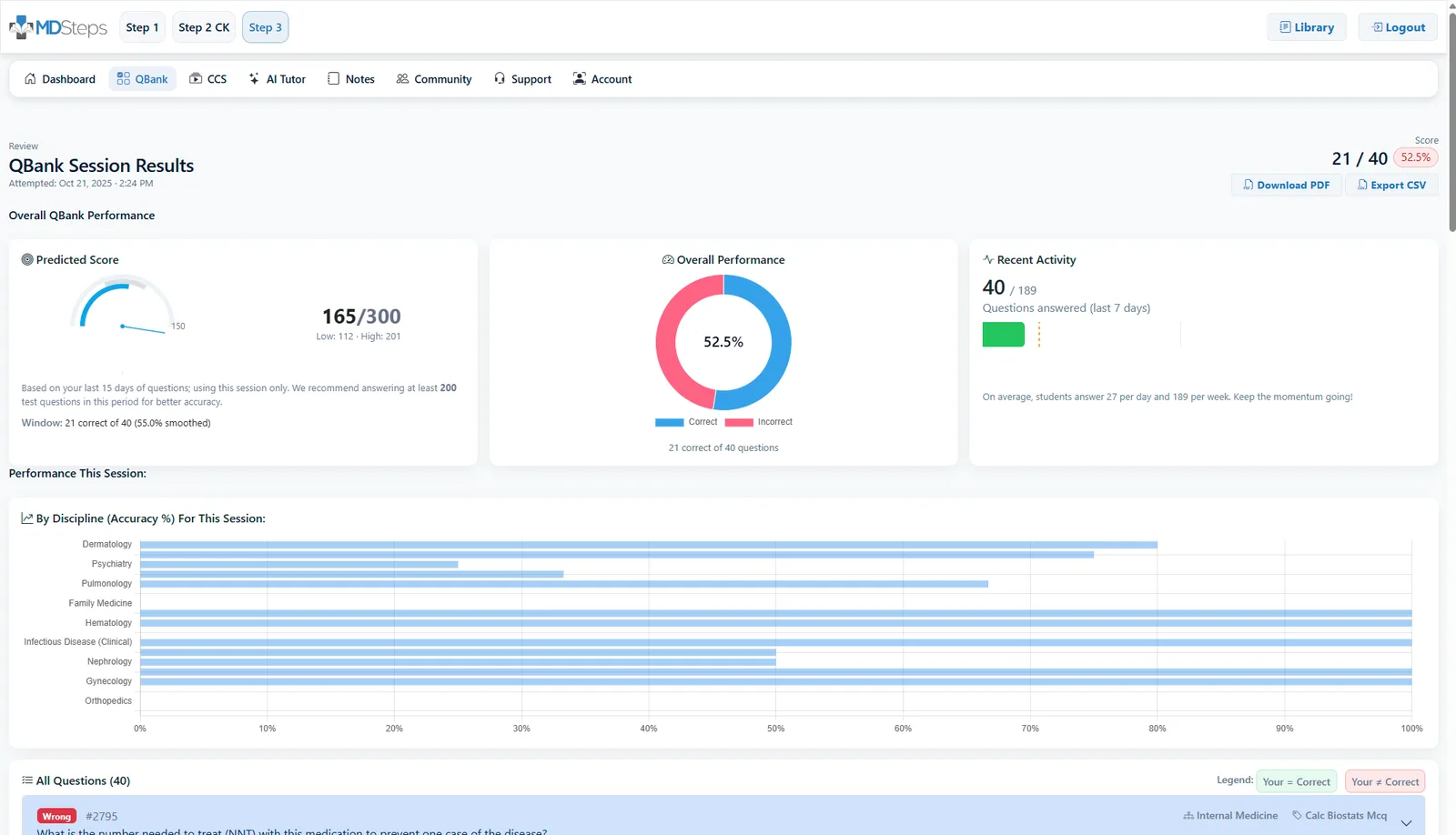
The change from Step 1 pass/fail to Step 2 CK is more than a harder exam—it’s a mindset pivot. On Step 1, you aimed to demonstrate minimal competence; for Step 2 CK, you must convert each block’s uncertainty into scored points. That requires reallocating your time toward strategies that demonstrably raise your percent correct: prioritizing high-yield clinical reasoning patterns, practicing time-aware decision making, and using analytics to attack your personal loss leaders. In the first 100 words of your plan, actually write the phrase “Step 2 CK scoring mindset” to keep the target explicit. You’re no longer trying to “know everything”—you’re optimizing how many questions you answer correctly under constraints. Step 2 CK rewards applied judgment: triaging differentials, choosing next-best tests, and anticipating complications. It also punishes over-reading, indecision, and perfectionism. A scoring mindset therefore values: (1) pattern recognition for common vignettes; (2) probabilistic thinking when data are incomplete; and (3) time-boxed elimination to protect easy points later in the block. You’ll audit your study week not by total hours or pages, but by questions converted and error types eliminated. MDSteps’ Adaptive QBank (16,000+ questions) and analytics dashboard surface weak links by system and cognitive skill, while the AI tutor and automatic flashcards (exportable to Anki) convert misses into targeted reps. Bottom line: a Step 2 CK scoring mindset is about deliberate practice aimed at point yield, not encyclopedic review. It’s ruthless about opportunity cost: if a study activity doesn’t improve conversion under time pressure, it’s deprioritized. Start with a target score anchored to program tiers you’re considering. Then, reverse engineer what percent correct you need per block to land there. Create a weekly point-yield plan: three high-quality QBank blocks/day (timed, random), same-day post-block analysis, and one consolidation block on the weekend using your personal error taxonomy. The Step 2 CK scoring mindset turns goals into behaviors with explicit metrics and calendar slots. Use MDSteps’ automatic study plan generator to slot blocks, reviews, and spaced consolidation. The analytics dashboard maps percent correct by system and question taxonomy so you can pick the highest-ROI objectives each week. If your 7-day rolling percent correct stalls, reallocate: fewer passive resources, more deliberate QBank reps, and shorter, daily micro-reviews of misses that recur. Deliberate practice is not just “doing questions.” It’s isolating the skill you lacked, then drilling it in conditions that resemble the exam. For a Step 2 CK scoring mindset, your unit of learning is the error pattern—not the chapter. After each block, label the miss: misread stem, premature closure, test-order logic, risk stratification, drug mechanism confusion, or guideline recall. Then build a 10–12 item micro-set in MDSteps that targets that exact skill with timed constraints. Finish every drill with a one-sentence “If/Then” rule (e.g., “If septic and hypotensive after fluids, then start norepinephrine.”). Leverage the MDSteps AI tutor to explain misses in plain, testable language and convert them to automatic flashcards. Export to Anki for spaced reinforcement. The scoring mindset demands compounding: each miss is a seed for reps you will never miss again. If you keep narrowing stems to two answers and picking the distractor, the problem may not be your medical knowledge. MDSteps shows the pivot clue, the trap answer, and the reasoning pattern behind the miss—then turns it into targeted practice. Most score losses happen inside the block, not in your knowledge base. Treat each 40-question block as a resource allocation problem with one currency: minutes. The Step 2 CK scoring mindset optimizes points per minute by identifying fast wins, deferring tar pits, and keeping reserves for end-of-block softballs. Practice this framework with MDSteps’ timed mode and analytics for median and 90th percentile time-per-question. The goal is not speed for its own sake but time regularity—smooth pacing prevents end-of-block collapses that cost 2–3 questions you would have nailed. The Step 2 CK scoring mindset concentrates on recurrent clinical patterns and a small set of guideline anchors that drive many questions. Build a living list you revisit weekly. Convert each anchor into a two-line flow. Use MDSteps custom sets to rehearse them under time. Tie your rapid reviews to these anchors so the last thing you practice each night is actionable: “If X, then Y test; if unstable, Y treatment.” A scoring mindset operationalizes the learning science that best predicts retention under stress. Use spacing to revisit volatile topics, interleaving to prevent pattern myopia, and retrieval practice to encode decision rules. MDSteps’ automatic flashcards from your misses, exportable to Anki, make spaced repetitions nearly frictionless. Guardrails: keep passive video time ≤ 20% of total; keep “notes per miss” ≤ 3 bullets; and schedule sleep as an exam intervention, not an afterthought. Interleave systems intra-day (e.g., cardio Qs in the AM, GI in the PM) to improve transfer. Your analytics should dictate next week’s plan—data, then design. Execution beats knowledge on test day. Treat your body like a device whose battery drains across 8 blocks. Pre-pack identical snack kits (fast carbs + protein + fluids), rehearse your break plan, and aim to keep cognitive load on the question, not the logistics. Decision fatigue is real. Use simple rules of thumb (e.g., “Order imaging after stabilization,” “Don’t anchor on buzzwords—confirm with data”). The Step 2 CK scoring mindset preserves decision quality late in the day through routines you’ve already rehearsed. In the final two weeks, shrink your world to what moves the score. Convert broad goals into narrow, repeatable actions. Remember, MDSteps can automate the hard parts: the Adaptive QBank personalizes your blocks; the AI tutor explains misses fast; automatic flashcards keep spacing consistent; and the analytics dashboard tells you exactly where the next point lives. That’s the essence of a Step 2 CK scoring mindset—every minute aimed at a measurable point gain.From Coverage to Conversion: What the Step 2 CK Scoring Mindset Really Means
Shift Your Metrics
Use the Right Tools
Reverse-Engineering the Score: Targets, Gaps, and a Weekly Point-Yield Plan
Component Metric Target Action Blocks/Day Completed (Timed, Random) 2–3 Schedule AM + PM; protect 2×45–60 min windows Percent Correct 7-day rolling ≥ +5–8 pts from baseline Focus on top 3 loss-leader systems Review Depth Notes per miss ≤ 3 bullets Short, testable takeaways → auto-flashcard Time Discipline Median seconds/question 75–85 s Practice 30–60–90 checkpoints Error Types Top 2 categories ↓ weekly Design mini-drills per category Designing Deliberate Practice: Turn Every Miss into a Future Make
Micro-Drill Template
Examples of High-ROI Drills
Learn the patterns behind your misses. Break the plateau.
Still missing questions you thought you understood?
Blockcraft: Timing, Triaging, and the Math of Points per Minute
The 30–60–90 Framework
Content That Moves the Needle: Clinical Patterns and Guideline Anchors
High-Frequency Patterns
Guideline Anchors to Memorize
Study Architecture: Spacing, Interleaving, and the Week that Scores
Day Morning Midday Afternoon Evening Mon–Thu Timed block (random) Targeted review + micro-drill Timed block (mixed weak systems) Spaced flashcards (20–30 min) Fri Two-block simulation Recovery walk + light notes Deep dive on top error type Short SR of volatile topics Sat Consolidation block AI tutor explanations Annotate anchor flows Spaced flashcards Sun Rest or half-day Wellness + sleep banking Plan next week from analytics Early lights out Test-Day Mechanics: Environment, Nutrition, and Cognitive Budgeting
Break Plan Template
Last-Mile Checklist
Rapid-Review Checklist & Your Final Two-Week Sprint
Rapid-Review Checklist
Two-Week Sprint Plan
Window Focus How You’ll Measure Days −14 to −8 Raise floor: eliminate top 2 error types Misses in those categories ↓ by ≥ 40% Days −7 to −4 Stabilize pacing; simulation + recovery Median time 75–85 s; ≤ 2 rushed guesses/block Days −3 to −1 Light touch; anchors + rest Quick wins retained; sleep ≥ baseline + 30 min Day 0 Execute the plan you practiced Breaks as scripted; “process over perfection”
References & Further Reading
USMLE Step 2 CK
How to Transition from Step 1 Pass/Fail to Step 2 CK Scoring Mindset

For students stuck despite doing more questions
UWorld explains the medicine. MDSteps explains the decision.
Traditional review often tells you the correct answer. MDSteps helps isolate the decision error: the missed pivot clue, the tempting distractor, the timing mistake, or the weak rule that failed under pressure.
Full access includes Step 1, Step 2 CK, Step 3, CCS cases, analytics, auto-flashcards, and study planning.
Pivot-clue review
See the exact phrase in the stem that should have changed your decision.
Distractor trap logic
Learn why the answer you almost picked felt right—and why it was wrong for this patient right now.
Miss-pattern analytics
Turn repeated mistakes into targeted blocks, flashcards, and readiness signals.
Tip: Track points saved each week by listing three previously missed patterns you answered correctly under timed conditions. That’s your momentum score.
Score stuck after more questions?
Free reasoning diagnostic
Pivot clue isolatedDistractor trap explainedNext study target identified
No credit card required for the free reasoning review. Full access is $27/month after that. Cancel anytime.
Reasoning diagnostic
Still missing the same kinds of questions?
Read why that happens.
Heuristic: Never let a single question consume the time of two straightforward questions. Protect future points.